
Blinking two LEDs using CD4047 is one of the simplest and most useful beginner electronics projects and this circuit uses the CD4047 IC in astable mode, so it generates a continuous square wave output without any external trigger. Because of this, the two LEDs blink one after another continuously, in which one LED turns ON […]
Simple Reverse Polarity Protection Buzzer Alarm Circuit
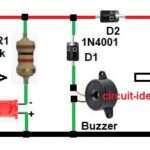
In many electronic circuits, wrong battery connection can damage sensitive components, therefore, a Simple Reverse Polarity Protection Buzzer Alarm Circuit gives an early warning before damage happens. This circuit is simple, low cost and easy to build, also it uses common parts like diode, resistor, LED and buzzer. When we connect the supply in the […]
EMF Ghost Detector Circuit using Arduino Uno and LCD Display
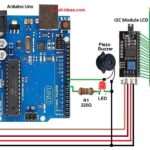
Nowadays, many hobby electronics users like to build interesting sensor projects and an EMF Ghost Detector is one such simple and exciting project. This EMF Ghost Detector Circuit using Arduino Uno and LCD Display detects electromagnetic field changes around electrical devices, wires and nearby electronic signals. Also, many people use this type of circuit for […]
0-15V 3A Adjustable Power Supply Circuit
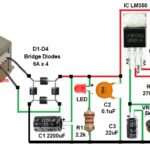
A 0-15V 3A Adjustable Power Supply Circuit gives adjustable DC voltage output from 0 volt to 15 volt and we use this circuit in electronic testing, small lab work, school projects and repair work, also this circuit helps us power many low-voltage devices safely. In this circuit, the LM350 voltage regulator IC controls the output […]
PIR Sensor Based PNP Switching Circuit for Output Control
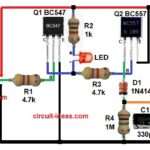
In this tutorial, circuit uses a PIR sensor to control an output load through transistor switching, but the main purpose of this circuit is to turn ON the output when motion is detected and when PIR sensor detects motion, it gives a trigger signal After that, the NPN transistor and PNP transistor work together as […]
5V 4A Power Supply Circuit using IC 7805 and Parallel Transistors
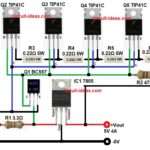
In this post, the below designed circuit gives a stable 5V DC output with high current up to 4A which uses the 7805 voltage regulator IC and multiple TIP41C transistors connected in parallel, because the normal 7805 IC alone gives around 1A current and we add external power transistors to increase the output current. Moreover, […]