• Skip to primary navigation
  • Skip to main content
  • Skip to primary sidebar

Circuit Ideas for You

Get free circuit ideas online.

  • Home
  • Privacy Policy
  • About
Home » Measuring Bend Angle using a Flex Sensor Circuit

Measuring Bend Angle using a Flex Sensor Circuit

Last updated on 24 November 2025 by Admin-Lavi Leave a Comment

Flex sensor is a small strip that changes resistance when we bend it.

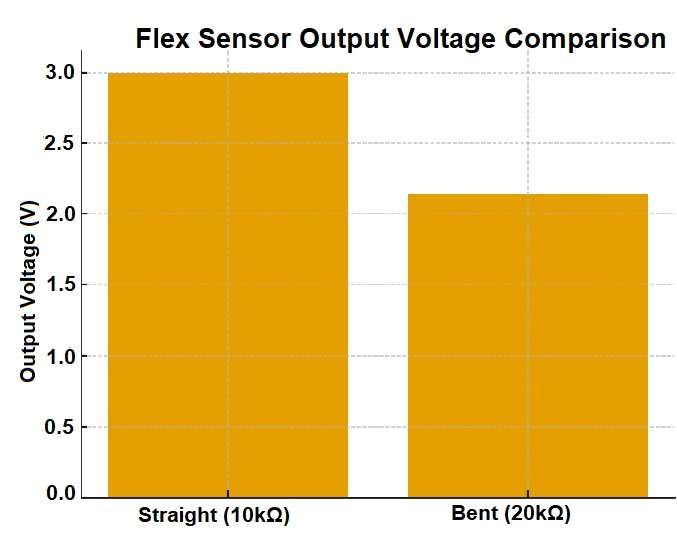
When straight, resistance is low.

When bent, resistance becomes high.

Many projects use this sensor.

It is used in robots, gloves, gaming, medical tools and wearables.

Sensor works simple with more bend gives more resistance.

Flex Sensor Output Voltage Comparison Graph:
Circuit Working:
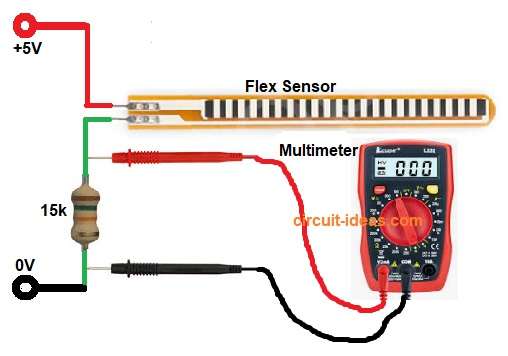
Measuring Bend Angle using a Flex Sensor Circuit Diagram

Parts List:

ItemQuantity
Resistor 15k 1/4 watt1
Flex Sensor1
Multimeter1

Flex sensor is like a resistor.

When we bend it, the material stretches.

Resistance goes up.

Microcontroller cannot read resistance directly.

So we use a voltage divider.

Flex sensor and a fixed resistor make a divider.

The divider gives changing voltage when sensor bends.

This voltage is easy to read by Arduino or meter.

How to Build:

For Measuring Bend Angle using a Flex Sensor Circuit follow the below steps:

  • Take all the parts as shown in circuit diagram.
  • Flex sensor pin 1 goes to 5V.
  • Flex sensor pin 2 joins with one side of 15k resistor.
  • Other side of resistor goes to ground.
  • The join point gives output voltage.
  • This output goes to multimeter positive or Arduino analog pin.
  • Ground of meter or Arduino goes to ground.

Conclusion:

Flex sensor is simple to use.

When it bends, resistance changes.

With a voltage divider, we get a changing voltage.

This voltage shows how much bend happens.

It is cheap and very common in motion and gesture projects.

Good for beginners and useful in many electronics ideas.

References:

Flex sensor bending angle and the corresponding sensor resistance.

Filed Under: Sensors and Detectors

About Admin-Lavi

Lavi is a B.Tech electronics engineer with a passion for designing new electronic circuits. Do you have questions regarding the circuit diagrams presented on this blog? Feel free to comment and solve your queries with quick replies

Previous Post: « Arduino Flex Sensor Circuit
Next Post: Arduino and Joystick LED Controller Circuit »

Reader Interactions

Leave a Reply Cancel reply

Your email address will not be published. Required fields are marked *

Primary Sidebar


Categories

  • Alarm Circuits (45)
  • Amplifier Circuits (67)
  • Arduino Projects (99)
  • Audio Circuits (114)
  • Automobile Circuits (19)
  • Battery Charger Circuits (65)
  • Free Energy (13)
  • Heater and Temperature Controllers (13)
  • High Voltage (1)
  • Indicator Circuits (45)
  • Inverter Circuits (20)
  • IoT projects (1)
  • LDR Circuits (26)
  • LED and Lamps (148)
  • Meters and Testers (30)
  • Motor Controllers (22)
  • Oscillator Circuits (39)
  • Power Supply Circuits (104)
  • Remote Control Circuits (10)
  • Security and Protection (29)
  • Sensors and Detectors (126)
  • Solar Circuits (29)
  • Timer Circuits (41)
  • Transistor Circuits (87)
  • Transmitter Circuit (17)
  • Tutorials (8)
  • Water Level Controller (6)

Recent Posts

  • 12V Battery Low Voltage Alarm Circuit
  • Low Voltage Alert Circuit for 9V Battery
  • Digital Code Lock Circuit using IC 4017
  • Darkness Activated LED Circuit
  • Fan Start 10 Second Delay Timer Circuit

Recent Comments

  1. TDHofstetter on DIY Variable Power Supply Circuit using Arduino
  2. feathbuff on Simple Micro Ampere Meter Circuit
  3. Admin-Lavi on Simple School Project Multimeter Circuit
  4. choke on Simple School Project Multimeter Circuit
  5. Admin-Lavi on Analog to Digital Converter Circuit using IC 555

Copyright © 2026 | New Circuit Ideas