
The Metal Detector Circuit using the CS209A IC is a useful tool for detecting nearby metal objects.
People use it for security screening, treasure hunting and industrial applications, also this article explains a simple yet effective metal detector circuit based on a single CS209A chip.
The circuit is easy to build and provides reliable metal detection performance and we can find metal from few inches away and also the circuit runs on 9V battery which is easy and useful for all.
Circuit Working:
Parts List:
| Components | Values | Quantity |
|---|---|---|
| Resistors (All resistors are 1/4 watt unless specified) | 10k | 1 |
| 220Ω | 1 | |
| 1k | 1 | |
| Potentiometer 10k | 1 | |
| Capacitors | Ceramic 2.2nF | 2 |
| Electrolytic 10µF 25V | 1 | |
| Semiconductors | IC CS209A | 1 |
| LED any 5mm, 20mA | 1 | |
| Coil Inductor 100µH | 1 | |
| Piezo Buzzer | 1 | |
| ON/OFF Switch | 1 | |
| 9V Battery | 1 |
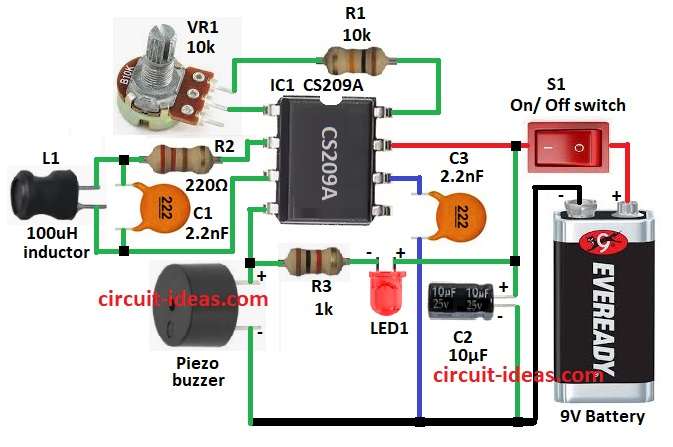
LC circuit with L1 and C1 makes fixed frequency and metal near L1 changes inductance and then frequency shifts.
Further, the CS209A chip detects this frequency change and turns on the output. LED1 lights up and the piezo buzzer sounds when the detector finds metal.
When metal goes away frequency is normal again with LED1 and buzzer OFF and then VR1 potentiometer changes circuit sensitivity.
Formulas with Calculations:
Formulas and calculations help to make simple metal detector using CS209A.
LC Frequency Formula:
f = 1 / (2 * π * √(L * C))
where,
- L is the 100µH
- C is the 2.2nF
Add values:
f = 1 / (2 * 3.1416 * √(100 * 10⁻⁶ * 2.2 * 10⁻⁹))
f = 339 kHz
The circuit runs at about 339 kHz with no metal present and when metal comes near the coil, the frequency changes and triggers the detector.
How to Build:
To build a Metal Detector Circuit using IC CS209A follow the below mentioned steps for connections of circuit:
- First, collect all parts shown in circuit diagram.
- Next, pin 1 of CS209A go to one side of VR1 and other side of VR1 go to R1 and then R1 go to pin 8 of IC.
- Then pin 2 go to one side of L1 through R2 and other side of L1 go to pin 3 and also C1 connect between R2 and L1.
- After that, pin 4 go to one side of piezo buzzer and other side of buzzer go to GND.
- Also, pin 6 go to GND with capacitor C3.
- Now pin 7 go to +9V battery through S1 switch and also connect C2 the positive to pin 7 and negative to GND.
- Finally, R3 and LED1 connects in series between pin 4 and buzzer and other end go to pin 7 and positive of C2.
Conclusion:
Therefore, this Metal Detector Circuit using IC CS209A is easy to build, works well and is good for beginners., also IC CS209A makes circuit small and strong for finding metal.
Also, if required change L and C values to set sensitivity for different needs.