Sun gives free energy every day and we can catch this energy and store in small batteries; also this Simple Solar Battery Charger Circuit does this job with very few parts.
Just one solar panel, one diode and four NiMH cells, with no complex electronics and no hard wiring and is good for beginners, students and for hobby makers.
Moreover, we can place panel in sun and battery start charging slowly like magic and is very easy project but very useful.
Circuit Working:
Parts List:
| Components | Quantity |
|---|---|
| Solar Panel 1W, 6V, 167mA | 1 |
| Diode 1N4001 | 1 |
| DC Motor 5V mini motor | 1 |
| NiMH Batteries AA size, 1600mAh, 1.2V | 4 |
| On Off Switch | 1 |
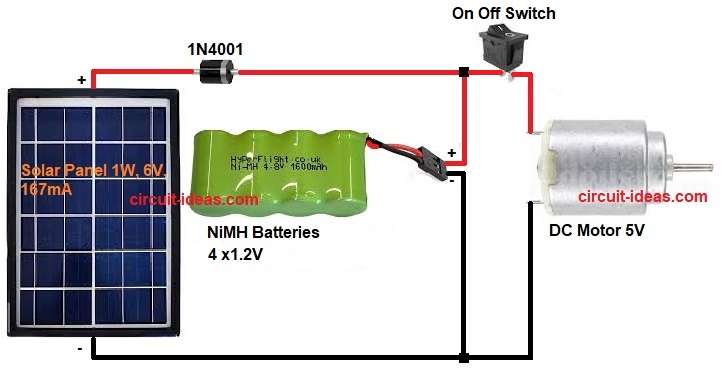
First, solar panel give around 6V in sun and current is around 160 to 170 mA and then diode 1N4001 stop battery from discharging back to panel when dark.
Also, batteries get charging current through diode.
Then switch turn motor ON and OFF and motor run from battery power and then solar panel only charge batteries and does not run motor directly.
Therefore, when sun is strong the charging is faster and when sun is weak the charging is slow.
Note:
We can run motor from solar only, for that just add second switch on battery positive wire an then switch OFF battery and solar panel will power motor directly.
How to Build:
To build a Simple Solar Battery Charger Circuit follow the below steps for connections:
- First, gather all the parts as shown in circuit diagram.
- Next, solar panel positive wire go to diode anode and diode cathode go to battery positive terminal.
- Then battery negative terminal go to solar panel negative and from battery positive go to one side of switch.
- Also, switch other side go to motor positive and motor negative go to battery negative.
Caution:
- Keep connections tight and use thick wire for battery and motor.
- Place solar panel in bright sun.
Conclusion:
To conclude, this Simple Solar Battery Charger Circuit is easy and tough and is good for small school project, also its good for learning solar charging basics.
With only few parts the circuit works slow but safe for NiMH batteries and is easy to make and easy to test.

Leave a Reply