If anyone’s project needs How to Generate a Safe 220V AC Supply from home power, then this is the circuit but we need to be careful.
This voltage is dangerous and to stay safe we can use a step-down transformer, as it makes voltage lower and safer and it also has safety parts to stop electric shocks.
Circuit Working:
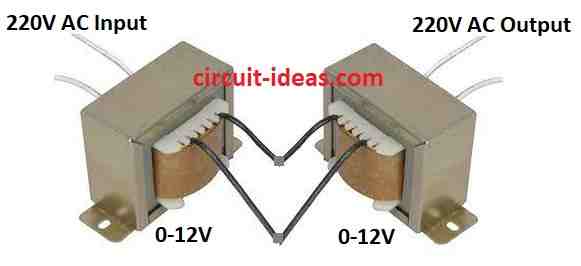
Parts List:
| Components | Values | Quantity |
|---|---|---|
| Transformers | 0-12V, 220V | 2 |
When working with mains power always follow safety rules to avoid electric shock.
This project uses 220V AC and a 15W transformer that limits the current to about 60 mA.
Although the transformer isolates the circuit from the mains and improves safety, the output can still deliver a dangerous electric shock.
If there is a short circuit then no fuse will blow but transformers will get hot and make buzzing sound, so we can use two same transformers and their watt decides max power output.
If the transformers differ, the output voltage changes and the smaller transformer limits the available power.
Therefore, this design does not provide complete protection, but it works well for projects such as switch-mode power supplies and capacitor-powered downlights.
Formulas:
From the circuit, we can see that the turns ratio is important because it shows the relationship between the input and output voltages of the transformer.
Formula:
Vs = Vp × (Ns / Np)
where:
- Vs is the Output voltage in secondary
- Vp is the Input voltage for primary
- Ns is the Turns in secondary coil
- Np is the Turns in primary coil
This means:
If Ns > Np then Vs > Vp → Step-up transformer
If Ns < Np then Vs < Vp → Step-down transformer
If Ns = Np then Vs = Vp → Isolation transformer
Note:
This formula is for perfect transformers, but in actual circuit the output voltage will be a bit less due to losses in copper and core loss.
How to Build:
How to Generate a Safe 220V AC Supply we need to follow the below mentioned steps for connections:
Safety First :
- Before starting know how to work with mains power.
- Wear rubber gloves.
- Use a circuit breaker for safety.
Transformer Connection:
- Connect both transformer primary coils in parallel to 220V AC mains, as this gives same voltage to both transformers.
Output Connection:
- Connect both secondary coils in series as this doubles the output voltage and the current will stay same.
Load Connection:
- Connect the device like SMPS or downlights to transformer output and be sure the device power is not more than transformer limit.
- Double check all wires before plugging in and if all is good then turn ON the power and test the circuit.
- Watch transformer heat during use and if too hot or buzzing then something is wrong; then turn OFF the power and fix the issue.
Note:
- This method is safer than direct mains but still dangerous, only people with right skills should try and if not sure call for an electrician for help.
Conclusion:
How to Generate a Safe 220V AC Supply we need to use step-down transformer with isolation, current limit, grounding and box.
Also, keep checking it regularly and follow the safety rules and if anyone is not sure about this project then always ask an expert.

Leave a Reply