To begin with, this article shows how to make Simple Battery Eliminator Circuits using 3 Methods with many useful features.
When we need steady DC power for devices then battery eliminator is very useful, as there is no need of normal batteries.
Furthermore, these circuits change AC from transformer to DC power for electronics; also it is very helpful for testing, making new projects or when wall power is better than using batteries.
Overall, we see three ways to make this circuit using diodes, capacitors, transformers and other parts.
Also, each method uses a different way to change and clean the AC voltage to get a more steady DC output.
Circuit Working with Formulas:
1. Battery Eliminator Circuit using a Single Diode 1N4007:
Parts List:
| Component | Specification | Quantity |
|---|---|---|
| Capacitor | Electrolytic 1000μF 25V | 1 |
| Diode | 1N4007 | 1 |
| Transformer | 0V-12V 5Amp | 1 |
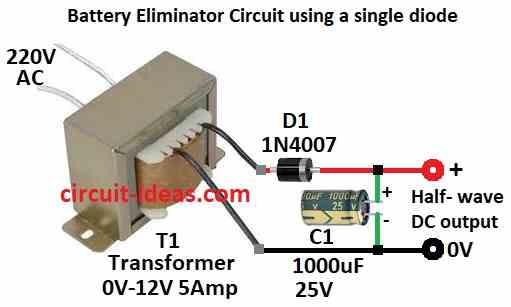
The above design is easy method uses one diode 1N4007 to change AC to DC, it also uses transformer 0V to12V 5A and capacitor C1 to 1000µF 25V.
Then transformer makes high AC voltage to low AC which is good for rectifier; after that one diode does half-wave rectification with only half AC pass, as a result it gives pulsing DC.
Finally, capacitor smoothers the pulsing DC to more steady DC voltage.
Formulas:
First, this circuit uses one diode to provide half-wave rectification in a battery eliminator.
Output DC Voltage:
VDC = VACrms / √2
where,
- VACrms is the AC voltage from transformer RMS value
- VD is the Diode drop to about 0.7V for 1N4007
Ripple Voltage:
Vripple = Iload / (f × C)
where,
- Iload is the load current
- f is the AC frequency from about 50 or 60 Hz
- C is the capacitance for 1000µF
How to Build:
To build a Battery Eliminator Circuit using a Single Diode follow the below mentioned steps for connections:
- First, connect one wire from transformer output to diode D1 anode and then connect other wire from transformer output to ground 0V.
- Then connect D1 cathode to positive side of capacitor C1 and also connect negative side of C1 to ground 0V.
2. Battery Eliminator Circuit using Two Diodes 1N4007:
Parts List:
| Component | Specification | Quantity |
|---|---|---|
| Capacitor | Electrolytic 1000μF 25V | 1 |
| Diode | 1N4007 | 2 |
| Transformer | 0V-12V 5Amp | 1 |
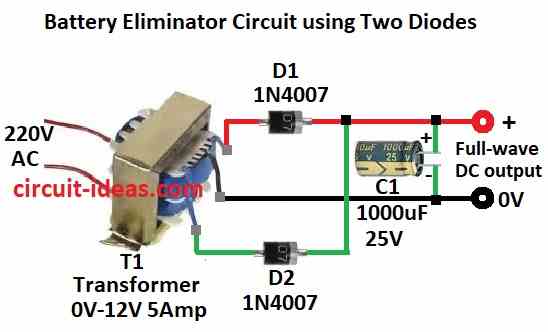
The above design method uses two diodes for full-wave rectification, and it is better than single diode way.
The transformer provides a 0–12V AC output, then, the two diodes rectify both halves of the AC waveform, as a result, the circuit produces a higher DC output with less ripple.”
Also, capacitor C1 1000µF 25V still smoothers the output to make steady DC.
Formulas:
Here, this battery eliminator uses two diodes and a center-tapped transformer to provide full-wave rectification.
Output DC Voltage:
VDC = VACrms / √2 – VD
where,
- Center tap transformer give two halves each VACrms / 2.
- Need to subtract diode drop VD with 0.7V per diode.
Ripple Voltage:
Vripple = Iload / (2 × f × C)
where,
- Iload is the load current
- f is the AC frequency with 50 or 60 Hz
- C is the capacitance with 1000µF
How to Build:
To build a Battery Eliminator Circuit using Two Diodes follow the below mentioned steps for connections:
- First, connect one outer wire from transformer to diode D1 anode, then connect center wire from transformer to ground 0V and then connect other outer wire from transformer to diode D2 anode.
- After that, join both D1 and D2 cathodes together and then connect joined cathodes to positive side of capacitor C1.
3. Battery Eliminator Circuit using a Bridge Rectifier (4 Diodes 1N4007):
Parts List:
| Component | Specification | Quantity |
|---|---|---|
| Capacitor | Electrolytic 1000μF 25V | 1 |
| Bridge Rectifier | Diode 1N4007 | 4 |
| Transformer | 0V-12V 5Amp | 1 |

Moreover, the above design uses the most advanced method, it employs four 1N4007 diodes to form a bridge rectifier.
Hence, compared to the other two methods, this approach converts the entire AC waveform into DC more efficiently and provides a more stable output.
Also, bridge rectifier fix both halves of AC wave and transformer still reduce AC voltage and then finally, then capacitor C1 with 1000µF 25V smooths the DC and give steady output for electronics.
Formulas:
In this design, a bridge rectifier works with the full-wave rectification formula to provide battery-eliminator operation.
Output DC Voltage:
VDC = VACrms / 2 − 2 × VD
where,
- VACrms is the AC voltage from transformer with RMS value
- VD is the diode drop with 0.7V × 2 = 1.4V total
Ripple Voltage:
Vripple = Iload / (f × C)
where,
- Iload is the load current
- f is the AC frequency from 50 or 60 Hz
- C is the capacitance for 1000µF
How to Build:
To build a Battery Eliminator Circuit using a Bridge Rectifier with with Full-Wave follow the below mentioned steps for connections:
- First, make bridge rectifier like in circuit diagram.
- Next, connect two AC input pins of bridge to transformer secondary wires.
- Now connect positive output of bridge to positive side of capacitor C1 and then connect negative output of bridge to negative side of capacitor C1.
Conclusion:
To conclude, Simple Battery Eliminator Circuits using 3 Methods give steady DC power from AC, also each method have different level of work and result.
Next, one diode method is very simple but ripple is high, as it uses half-wave rectification; then two diode method is better and it use full-wave rectification, less ripple and is more efficient.
Finally, bridge rectifier with four diodes is best, as it give full-wave DC with low ripple and is also very smooth.
Therefore, the choice of method depends on how smooth a DC output we need and how much circuit complexity we can accept.
In addition, all three methods help you understand how electronic circuits convert and filter AC power to produce DC power.

Leave a Reply