• Skip to primary navigation
  • Skip to main content
  • Skip to primary sidebar

Circuit Ideas for You

Get free circuit ideas online.

  • Home
  • Privacy Policy
  • About
Home » Simple DC Bulb Circuit

Simple DC Bulb Circuit

Last updated on 14 October 2025 by Admin-Lavi Leave a Comment

Want to light up a bulb by using just a battery and switch?

This Simple DC Bulb Circuit is the easiest way to understand how electricity flows and powers small devices.

A perfect starting point for anyone new to electronics.

Circuit Working:
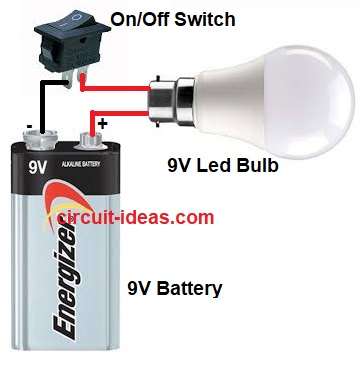
Simple DC Bulb Circuit Diagram

Parts List:

Component NameSpecificationQuantity
Battery9V1
On/Off SwitchSPST1
LED Bulb9V DC1

The battery gives DC voltage.

The switch controls current flow.

When the switch is ON, current flows from the battery positive to the bulb and then back to the negative terminal.

The bulb glows because current passes through its filament.

When the switch is OFF then current stops and the bulb goes dark.

Formulas with Calculations:

Formulas for Simple DC Bulb Circuit:

Voltage (V) = Battery voltage

Current (I) = V / R

Power (P) = V × I

If battery = 9V and bulb resistance R = 18 ohms

Then I = 9 / 18 = 0.5A

Power P = 9 × 0.5 = 4.5W

How to Build:

  • To build a Simple DC Bulb Circuit follow the below steps:
  • Take all the parts as shown in circuit diagram.
  • Connect the positive terminal of the battery to one side of the switch.
  • Connect the other side of the switch to one terminal of the bulb.
  • Connect the other terminal of the bulb back to the negative terminal of the battery.

Conclusion:

This Simple DC Bulb Circuit is very easy to make.

It shows how electric current flows and how a switch controls it.

It is perfect for beginners and electronics students.

References:

Simple DC Circuit with 3 Devices

Filed Under: LED and Lamps

About Admin-Lavi

Lavi is a B.Tech electronics engineer with a passion for designing new electronic circuits. Do you have questions regarding the circuit diagrams presented on this blog? Feel free to comment and solve your queries with quick replies

Previous Post: « Logic XNOR Gate Circuit with Transistors
Next Post: Simple Battery Level Indicator Circuit »

Reader Interactions

Leave a Reply Cancel reply

Your email address will not be published. Required fields are marked *

Primary Sidebar


Categories

  • 555 Timer Projects (17)
  • Alarm Circuits (56)
  • Amplifier Circuits (73)
  • Arduino Projects (102)
  • Audio Circuits (136)
  • Automation Circuits (4)
  • Automobile Circuits (22)
  • Battery Charger Circuits (75)
  • DIY Projects (21)
  • Free Energy (13)
  • Heater and Temperature Controllers (20)
  • High Voltage (11)
  • Hobby Circuits (2)
  • Indicator Circuits (56)
  • Inverter Circuits (19)
  • IoT projects (1)
  • LDR Circuits (34)
  • LED and Lamps (173)
  • Meters and Testers (35)
  • Motor Controllers (22)
  • Oscillator Circuits (44)
  • Power Supply Circuits (180)
  • Remote Control Circuits (9)
  • Security and Protection (41)
  • Sensors and Detectors (155)
  • Solar Circuits (31)
  • Timer Circuits (48)
  • Transistor Circuits (130)
  • Transmitter Circuit (17)
  • Tutorials (8)
  • Voltage Regulator (1)
  • Water Level Controller (7)

Recent Posts

  • UJT Based High Voltage Mini Audio Amplifier Circuit
  • Transformerless Audio Amplifier Circuit using Germanium Transistor
  • Low Impedance Driver Circuit using BJT Transistor
  • How to Replace IC TDA2050 with LM1875 IC in Audio Amplifier Circuit
  • Transistor Based Audio Amplifier Circuit

Recent Comments

  1. Admin-Lavi on Alternate Red Green LED Flasher Circuit
  2. Admin-Lavi on Alternate Red Green LED Flasher Circuit
  3. Mike on Alternate Red Green LED Flasher Circuit
  4. angel on 12 Watts Amplifier Circuit using Transistors
  5. Simple 1.5V Single Cell LED Flasher Circuit - Circuit Ideas for You on Simple 1.5V White LED Flasher Circuit

Copyright © 2026 | New Circuit Ideas