
Here, is a article for a Simple PIR Sensor Timer Circuit using Transistors.
It is with low cost and easy to build and it works with 12V DC supply.
When motion is detected the output stays ON for some time.
After delay the output turns OFF automatically.
Hence, this circuit is useful for lights, alarms and automation projects.
Circuit Working:
Parts List:
| Components | Part Value | Quantity |
|---|---|---|
| Resistors | 4.7k | 2 |
| 1k, 1M | 1 each | |
| Capacitor | Electrolytic 330uF 25V | 1 |
| Semiconductors | Transistor 2N2222 NPN | 1 |
| Transistor 2N2907 PNP | 1 | |
| Diode 1N4148 | 1 | |
| Sensor Module PIR Motion Sensor | 1 | |
| LED any color | 1 | |
| Power Supply 12V DC | 1 |
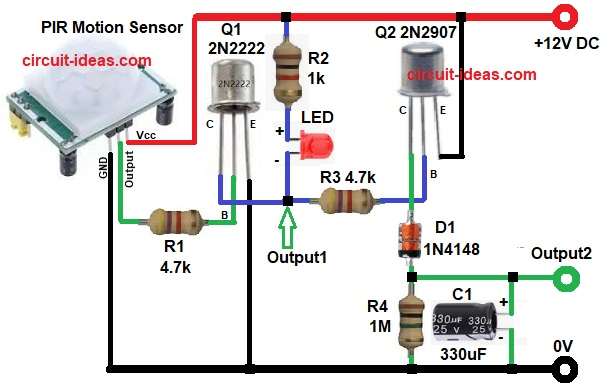
This circuit starts first with PIR sensor detects motion.
Then PIR output goes HIGH and this signal passes through resistor R1, which turns ON transistor Q1.
When Q1 turns ON the current flows from collector to emitter.
LED1 glows through resistor R2 and this shows motion detected.
Output1 goes low instantly when motion is detected because Q1 turns ON and it goes high when there is no motion because Q1 turns OFF.
At the same time, signal reaches base of transistor Q2 via R3.
Q2 is a PNP transistor and so it turns ON when base goes LOW.
When Q2 turns ON the capacitor C1 starts charging.
Charging is done through diode D1 and resistor R4.
During this time the output2 remains HIGH.
After PIR output becomes LOW then Q1 turns OFF.
But capacitor C1 is still charged and so Q2 stays ON for some time.
Slowly, capacitor C1 discharges through R4.
When voltage drops transistor Q2 turns OFF and then output2 goes LOW.
This creates the time delay function.
Formula with Calculation:
Timer delay mainly depends on resistor R4 and capacitor C1.
Simple formula is:
Time delay T = R × C
here,
- R value is 1M ohm
- C value is 330uF
First convert microfarad to farad.
330uF becomes 0.00033F
Now we can calculate:
T = 1,000,000 × 0.00033
T = 330 seconds
So delay time is around 5 to 6 minutes.
Actual delay can change little bit.
How to Build:
To build a Simple PIR Sensor Timer Circuit using Transistors follow the below steps for connection:
- Collect all the parts as shown in circuit diagram.
- PIR Sensor V+ pin connects to +12V.
- V- pin connects to GND.
- Out pin connects to R1.
- Transistor Q1 2N2222 base pin connects to R1.
- Emitter connects to GND.
- Collector connects to output1, LED1 cathode and R2 in series.
- LED1 Anode connects to one end of R2 and other end of R3 connect to positive supply.
- Transistor Q2 2N2907 emitter pin connects to +12V.
- Base pin connects to R3.
- Collector connects to anode of diode D1.
- Cathode of D1 connects to output2 and capacitor C1 positive and one end of resistor R4.
- Capacitor C1 positive pin connects to output2.
- Negative pin connects to GND.
- Resistor R4 one side connects to output2 .
- Other side connects to GND.
- Power Supply positive supply connects to +12V rail.
- Negative connects to GND rail.
Conclusion:
This Simple PIR Sensor Timer Circuit using Transistors is very reliable.
It uses easily available components and it gives adjustable delay by changing R4 or C1.
It is suitable for beginners and hobby projects.
At last, we can use it for lights, alarms or relays.