
This post is for simple 2N3055 Based 12V DC Voltage Regulator Circuit, which gives stable 12V output and is useful for power supply projects.
For example, battery charger, amplifier supply, small lab supply and this circuit is easy to build.
The circuits components are with low cost and easily available.
Basically, this regulator works as series pass transistor regulator, and a zener diode controls the base voltage.
Then transistor controls the output voltage and as a result, output stays near 12V even if input changes a little.
Circuit Working:
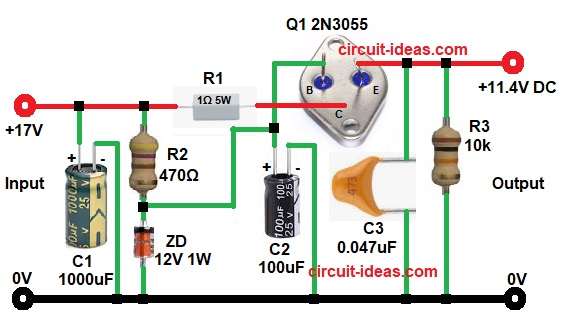
Parts List:
| Component | Value | Quantity |
|---|---|---|
| Resistors | 1Ω 5W, 470Ω 1/2W, 10k 1/4 W | 1 each |
| Capacitors | Electrolytic 1000uF 25V, 100uF 25V | 1 each |
| Ceramic 0.047uF 50V | 1 | |
| Semiconductors | Zener Diode 12V 1W | 1 |
| 2N3055 NPN Power Transistor | 1 |
First, unregulated DC input is applied to the circuit, in the diagram above input is about 17V DC.
C1 works as filter capacitor, it reduces ripple from rectifier and therefore, input becomes smoother DC.
Next, R2 supplies current to Zener diode and this Zener is 12V, it maintains constant 12V at its cathode.
The base of 2N3055 is connected to Zener voltage and therefore, base voltage becomes almost 12V.
Now, transistor works as emitter follower and this emitter voltage is always about 0.7V less than base voltage, so output voltage becomes:
Vout = Vz – Vbe
If Zener is 12V and Vbe is 0.7V then:
Vout = 12 – 0.7
Vout = 11.3V
So output is approximately 11.4V as shown in diagram.
R1 1 Ohm is used as current sensing resistor and it limits current slightly and protects transistor.
C2 100uF improves stability of regulator and it reduces noise.
C3 0.047uF removes high frequency noise at output.
R3 10k acts as bleeder resistor and it discharges output capacitor when supply is OFF.
Thus, output becomes stable DC around 12V.
Formulas with Calculation:
- Zener Resistor R2 Calculation:
R2 = (Vin – Vz) / Iz
where:
- Vin is input DC voltage
- Vz is Zener voltage
- Iz is Zener current
Example:
Vin is 17V
Vz is 12V
Desired Iz = 10mA = 0.01A
R2 = (17 – 12) / 0.01
R2 = 5 / 0.01
R2 = 500 Ohm
Nearest standard value of 470Ω resistor is used in this circuit.
2. Power Dissipation of Transistor:
P = (Vin – Vout) x Iload
Example:
- Vin is 17V
- Vout is 11.4V
- Iload is 2A
P = (17 – 11.4) x 2
P = 5.6 x 2
P = 11.2 Watt
So large heat sink is required, use medium to large aluminum heat sink or thermal grease is also fine.
How to Build:
To build a 2N3055 Based 12V DC Voltage Regulator Circuit follow the following connection steps:
- Start, the circuit by collecting all the circuit parts.
- Then start with transistor Q1 collector pin connect to unregulated positive input of 17V through resistor R1.
- Base connect to junction of R2 and Zener diode.
- Emitter connect to output terminal of 11.4V.
- Resistor R2 one end connect to input positive and other end connect to Zener cathode and transistor base.
- Zener Diode cathode connect to base of transistor Q1 and anode connect to ground 0V.
- Capacitor C1 positive end connect to to input positive and negative to ground.
- Capacitor C2 positive connect to junction of transistor Q1 base, resistor R2 and Zener diode and negative to ground.
- Capacitor C3 one side to output and other side to ground.
- R3 connect between output and ground.
Important Notes
- Always use proper heat sink for 2N3055.
- Input voltage must be at least 2V to 3V higher than output.
- This is linear regulator and its efficiency is low at high current, for for higher efficiency, switching regulator is better.
Conclusion:
This 2N3055 Based 12V DC Voltage Regulator Circuit is simple and reliable project.
It gives stable output for medium current applications and its components are common and cheap.
However, heat dissipation is high so good heat sink is necessary.
Overall, it is good learning project and useful power supply for hobby electronics.