
Electronics is very interesting and amplifier circuits are very useful, as one of the basic amplifiers is the common emitter amplifier.
This circuit uses an NPN transistor to amplify a small input signal into a larger output signal; therefore, designers use this circuit in sensors, audio circuits and switching applications.
In short this article explains about a simple Low Cost NPN Transistor Amplifier Circuit.
Circuit Working:
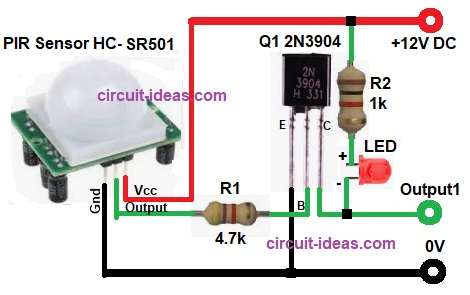
Parts List:
| Components | Values | Quantity |
|---|---|---|
| Resistors | 4.7k, 1k 1/4 watt | 1 each |
| Semiconductors | Transistor 2N3904 NPN | 1 |
| Any color LED | 1 | |
| PIR Sensor HC-SR501 | 1 | |
| Power supply 12V | 1 |
At first, the power supply activates the circuit and when the input signal reaches the base, it forward biases the base emitter junction.
A small base current controls a much larger collector current, then this collector current changes the voltage across the collector load, producing the output signal at the collector.
When input is high the transistor turns ON and so the LED glows and when input is low then the transistor turns OFF and so the LED turns OFF.
Hence, the amplification and switching both happen.
Formula with Calculation:
Base Current Formula:
Ib = (Vin – Vbe) / Rb
Calculation as per the circuit:
Ib = (3.3 − 0.7) / 4700
Ib = 2.6 / 4700, Ib = 0.00055 A
= 0.55 mA
So base current is small to about 0.55 mA which is safer for our transistor.
How to Build:
To build a Low Cost NPN Transistor Amplifier Circuit follow the below steps for connection:
- First, collect all components and see the circuit diagram clearly and then start the work.
- Next, emitter pin of transistor Q1 go to ground, base pin of Q1 connect to sensor OUT pin and put resistor R1 in between and then collector pin of Q1 connect to LED cathode.
- Also, LED anode connect to one end of resistor R2 then other end of resistor R2 go to +12V supply.
- Now connect PIR sensor pins, with V+ pin go to +12V and V- pin go to ground and then sensor OUT pin go to base resistor R1.
- Finally, we finish building the circuit.
Conclusion:
To conclude, this Low Cost NPN Transistor Amplifier Circuit is very useful, as it is simple and effective and it amplifies small signals easily.
Also, it can work as a switch, making this circuit ideal for beginners; many electronics projects also use this circuit.