
Ever wondered how fog horns make that deep, spooky sound?
In the same way, this Fog Horn Circuit is a small sound-making device that uses electronics to produce the low, rising and falling fog horn noise.
Moreover, people use these circuits for fun projects as well as for learning electronics.
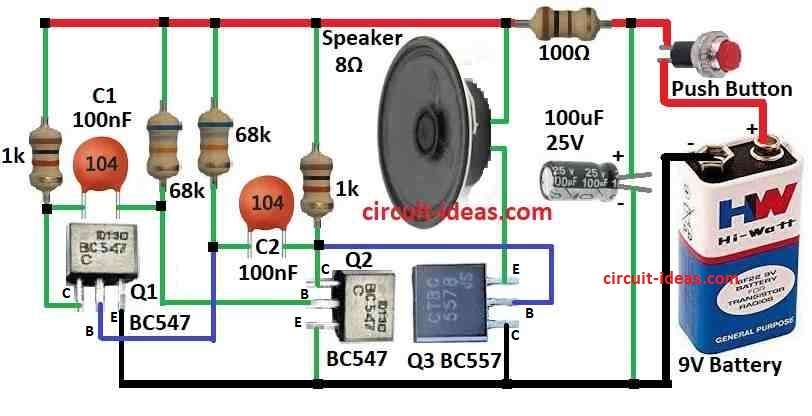
Circuit Working:
Parts List:
| Components | Values | Quantity |
|---|---|---|
| Resistors ( All resistors are 1/4 watt unless specified) | 100Ω | 1 |
| 1k | 2 | |
| 68k | 2 | |
| Capacitors | Ceramic 100nF | 2 |
| Electrolytic 100µF 25V | 1 | |
| Semiconductors | Transistors BC547 | 2 |
| Transistor BC557 | 1 | |
| Speaker 8Ω | 1 | |
| Push button | 1 | |
| Battery 9V | 1 |
In this article, the circuit runs on a 9V battery because it uses two BC547 transistors and one BC557 transistor in a three-stage amplifier setup to boost the oscillator signal.
Furthermore, the oscillator consists of resistors and capacitors; when we press the push button, a 100µF capacitor charges through a 1 kΩ resistor.
Additionally, as it charges, the pitch of the sound rises and when we release the button, the capacitor discharges through the speaker; consequently, the pitch falls until the sound stops.
An 8 Ω speaker plays the sound produced by the oscillator and the push button starts and stops this process, thereby creating the fog horns rising and falling sound.
Formulas:
To design a fog horn circuit, we need an oscillator to drive a loudspeaker and therefore, here is a simple explanation with the main formulas and parts:
1. Oscillator Design
Use an astable multivibrator to generate the sound signal.
Oscillation Frequency Formula:
f = 1.44 / (R1 + 2 * (R2 + R3)) * C
where,
- R1, R2 and R3 are resistors in the oscillator.
C is the capacitor.
Change resistor and capacitor values to get the fog horns deep tone.
2. Transistor Base Resistor Calculation
To control the transistor BC547 or BC557 calculate the base resistor RB:
RB = (Vin – VBE) / IB
where,
- Vin is the input voltage which is usually 9V
- VBEis the base-emitter voltage drop which is about 0.7V for silicon transistors)
- IB is the desired base current
3. Speaker Current Limiting Resistor:
Protect the 8Ω speaker and ensure proper sound output:
Rspeaker = (Vsupply – Vspeaker) / Ispeaker
- Vsupply is the power supply for 9V
- Vspeaker is the speaker impedance for 8Ω
- Ispeaker is the desired current based on loudness and power rating
4. Circuit Summary
Use BC547 transistors for the oscillator and use a BC557 transistor for amplification.
Additionally, drive an 8 Ω speaker to produce sound, and use a push button to trigger the charging and discharging of a capacitor; as a result, the pitch rises and falls like a real fog horn.
Note: Adjust the resistor and capacitor values and test the circuit to fine-tune the sound.
How to Build:
To build a Fog Horn Circuit follow the below mentioned steps for components connections:
Transistor Amplifier Stages:
- First, the base of the Q1 BC547 transistor connects to a 68 kΩ resistor, and this resistor connects to the positive output of the oscillator.
- Next, the collector of Q1 connects through a 1kΩ resistor to the base of a second BC547 transistor.
- Then, the collector of the second BC547 connects through a 68 kΩ resistor to the base of a BC557 transistor.
- After that, the collector of the BC557 connects to the positive terminal of the speaker.
- Also, the emitters of both BC547 transistors connect to the negative terminal (GND) of the battery.
- Lastly, the emitter of the BC557 connects to one end of the speaker, while the other end of the speaker connects to the positive terminal of the battery.
- Next, a 100nF capacitor C2 connects to the base of the first BC547 Q1 through a 68 kΩ resistor.
- Also, one end of another 100nF capacitor C1 connects through a 1kΩ resistor to the base of the BC557 Q3; meanwhile, the other end of C1 connects through a 1kΩ resistor to the collector of Q1 and through a 68 kΩ resistor to ground.
Conclusion:
Overall, this Fog Horn Circuit is a fun and simple electronics project that uses capacitors and transistors to create a sound that rises and falls in pitch just like a real fog horn.
Moreover, we can tweak the component values to change the sound and learn basic electronics in the process; but however, always follow safety precautions while building the circuit.