
To begin with, this easy Heads or Tails Decision Maker Circuit show how to make fun coin flipper using electric, for example like when we flip real coin but here we press a button and small chip inside do fast thinking and then say “heads” or “tails” very quickly
The circuit also uses logic parts and small electric pieces to give random answer, so it is a fun and interesting way to solve small problems.
Circuit Working:
Parts List:
| Components | Values | Quantity |
|---|---|---|
| Resistors | 100k 1/4 watt, 470Ω 1/4 watt | 1 each |
| 150k 1/4 watt | 2 | |
| Capacitors | Ceramic 4.7nF | 1 |
| Ceramic 100pF | 2 | |
| Electrolytic 1µF 25V | 1 | |
| Semiconductors | Transistors BC557 | 2 |
| IC4093 (N1 to N4) | 1 | |
| LEDs Red / Green | 2 | |
| Switches ON / OFF Switch | 1 | |
| Push to OFF Switch | 1 | |
| Battery 9V | 1 |
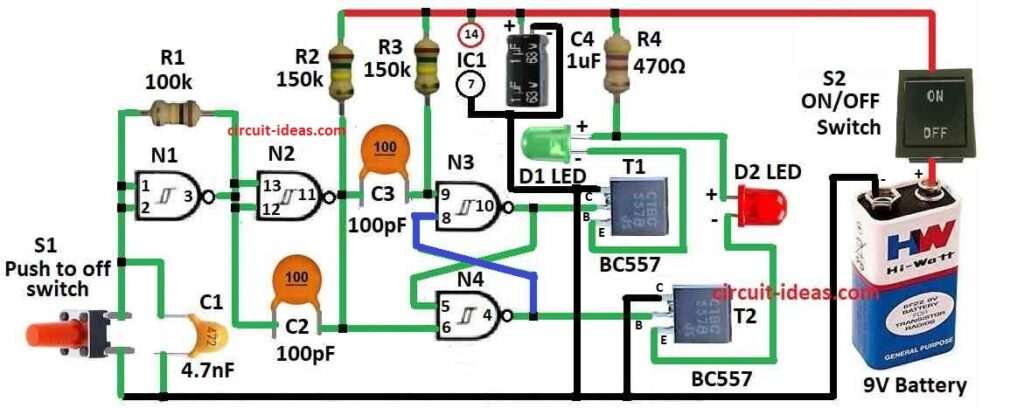
The above circuit shows flip flop using N3 and N4 with N2 is working from square wave maker made by gates N1, R1 and C1.
Also, transistors T1 and T2 take output from flip flop and turn ON LEDs D1 and D2 one by one.
When we press the button, both LEDs blink fast and after some time, one LED stays ON while the other turns OFF.
These LEDs called “heads” and “tails” to give random decision.
At first, the design included one more LED, but later we removed it because people can now decide by themselves, hence, this is a highly sensitive circuit which gives true random results for heads or tails.
Furthermore, many hobby circuits exist, but this article shows this one.
Formulas:
We make simple formula for NAND gate oscillator to guess the frequency (f) under some thinking:
Also, charging and draining time are same, this means resistor and capacitor have same value in both ways (R1 = R2, C1 = C2).
NAND gate works perfect, so we ignore small delay inside the gate.
So using these ideas the formula is:
f = 1.44 / (R * C)
where:
- f is how many times it goes ON/OFF in 1 second like in Hz
- R is the resistor value in ohms Ω
- C is the capacitor value in farads F
How to Build:
To build a Heads or Tails Decision Maker Circuit follow the below mentioned connections steps:
- First, put the silicon chips on breadboard and use them to make digital logic gates and after that connect input and output as needed.
- Next, use gates N1, resistor R1 and capacitor C1 to build square wave generator and this will control the flip flop.
- Also, use NAND gates N3 and N4 to make flip flop and be sure it gives two different outputs one after other.
- Then to turn ON and OFF LEDs D1 and D2 use transistors T1 and T2, now connect them properly to switch lights.
- After that, put the push button in the circuit and press it to begin the decision process.
- Next, give good power to the circuit and use battery or any other proper power source.
- Now, press the button and see how LED changes and also check if the result looks random.
Conclusion:
To conclude, this Heads or Tails Decision Maker Circuit can help in many ways like solving fights, choosing something or adding fun to games.
Moreover, it is also a cool use of electric parts that acts like real coin toss.