This article make it easy to build one Modified Sine Wave Inverter Circuit, which uses two small chips IC 4017 and IC 555 to make square wave look more smooth.
Also, the circuit shows all parts and how wires connect so we can understand better.
Understanding Modified Sine Wave Inverter:
In the beginning, battery power can change to home power using different types of inverters.
Also, a modified sine wave inverter is better than a basic one, as a basic inverter makes a blocky wave and a modified one makes a smoother wave for some machines.
Therefore, the main difference is simple. A normal switch goes up and down fast. A modified sine wave stops at zero for a short time before changing direction.
Comparing Square Wave and Modified Sine Wave Inverters:
Firstly, square wave inverter work like fast ON/OFF light switch, it turn electricity ON and OFF very quickly which can be bad for some machines.
Furthermore, modified sine wave inverter is more smooth like dimmer switch and it stops at zero for small time before changing the direction and this make power more clean and less trouble for devices.
Hence, it is not perfect like real sine wave but much better than square wave.
Understanding the Modified Inverter Circuit:
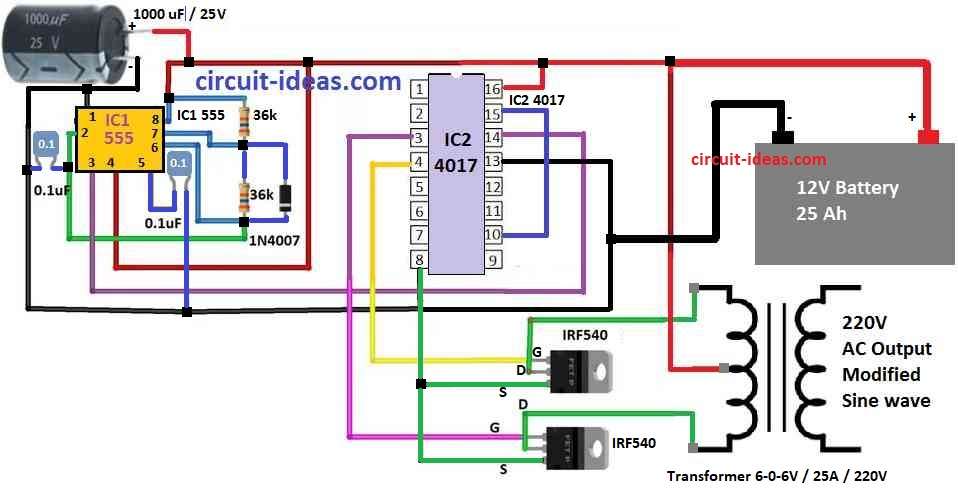
Parts List:
| Components | Quantity |
|---|---|
| Resistors | |
| 36k 1/4 watt | 2 |
| Capacitors | |
| PPC 0.1µF | 2 |
| Electrolytic 1000µF 25V | 1 |
| Semiconductors | |
| Diode 1N4007 | 1 |
| IC 4017 | 1 |
| IC 555 | 1 |
| MOSFET IRF540 | 2 |
| Transformer 6-0-6V / 25A / 220V | 1 |
| Battery 12V 25Ah | 1 |
The modified inverter make modified sine wave at output which have different parts like:
Oscillator Stage (IC 555):
First, this part is very important as it makes clock signal for inverter and is like heart of a circuit, for this we use IC 555 as oscillator.
In addition, if we want to make a 200Hz square wave with a 50% duty cycle, we use IC 4017 to divide it by 4 and generate a 50Hz AC modified sine wave.
Also, we can find the frequency of IC 555 using the following formula:
Formulas and Calculations:
Below are formulas and calculation for making Modified Sine Wave Inverter:
Frequency = 1.44 / (R1 + R2) × C
Duty Cycle = R1 / (R1 + R2)
We use values from circuit diagram to put in formula:
Frequency = 1.44 / (36000 + 36000) × 0.1 × 10⁻⁶ = 200 Hz
Duty Cycle = 36000 / (36000 + 36000) = 0.5
Duty Cycle = 0.5 × 100% = 50%
Let us analyze this on the scope:
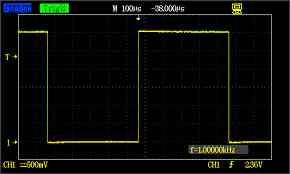
Furthermore, about component limits the scope reading shows circuit is working close to expected values.
Important Note:
Moreover, the 0.1uF capacitor at pin 5 of IC 555 is very important it helps to stop outside noise and if we do not use this capacitor frequency and duty cycle can change from what we calculate.
Wave Shaping Stage (IC 4017):
Additionally, in this part we apply a 50 Hz, 50% duty cycle signal to IC 4017 and this chip works as a decade counter and helps generate a modified sine wave.
Furthermore, IC 4017 has 10 output pins and one input pin is pin 14 and when clock signal connects to this pin 14 each output pin turns ON one by one.
For example: after 5 clock signals, pin 5 output becomes active and others stay OFF.
Also, pin 15 is a reset pin and it can bring count back to 0 if we do not use all 10 outputs.
As a result, in our circuit we only use 4 output pins: pin 3, 2, 4 and 7 (Q0, Q1, Q2, Q3).
Furthermore, pin 15 connects to Q4 at pin 10, so only pins 3, 2, 4 and 7 remain active and the other outputs stay OFF.
Hence, we give 200Hz signal to pin 14 of clock pin of IC 4017.
Also, we only use two of the outputs, pin 3 (Q0) and pin 4 (Q2) and leave the other pins unconnected.

Moreover, the system takes a modified sine wave from pins 3 and 4 and connects it to MOSFETs to strengthen it, allowing us to view the wave on an oscilloscope.

Leave a Reply