When we plug in Precision Electronic Rat Repellent Circuit device, it makes high loud noise that rat and mouse do not like.
Also, humans and most animals cannot hear this noise because of its very high frequency, hence, this device is a good choice if we do not want to use poison, as it produces strong sound waves that scare rats and drive them away.
What is Electronic Rat Repellent Circuit:
Electronic rat repellent circuit is small device which makes ultrasonic sound to keep rats and mice away.
Rat can hear very high sound like 30kHz to 50kHz which human do not can hear this, so when the rat hear this high sound then they do not feel good, so they run away from that place.
Circuit Diagram:
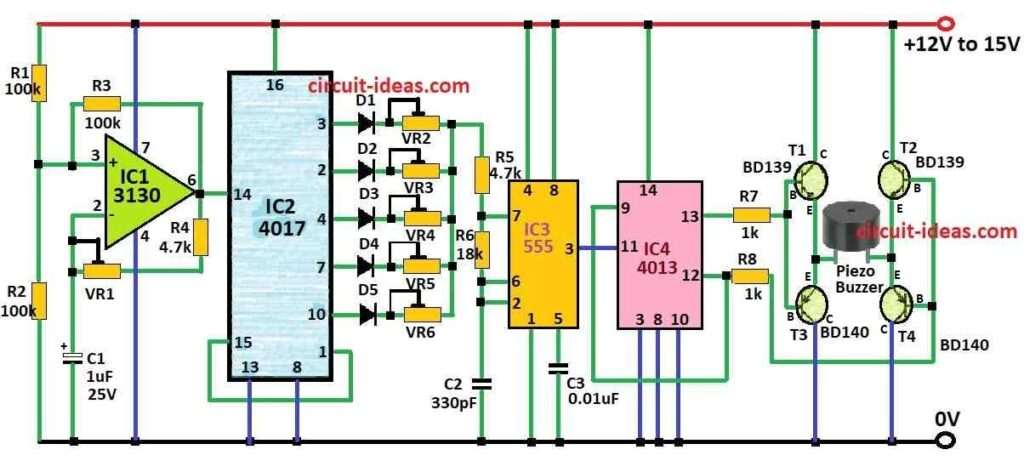
Parts List:
| Components | Quantity |
|---|---|
| Resistors (All resistors are 1/4 watt unless specified) | |
| 100k | 3 |
| 4.7k | 2 |
| 1k | 2 |
| 18k | 1 |
| Preset VR1 470k | 1 |
| Presets VR2 to VR6 100k | 5 |
| Capacitors | |
| Ceramic 330pF | 2 |
| Ceramic 0.01μF | 2 |
| Electrolytic 1μF 25V | 1 |
| Semiconductors | |
| IC 3130 | 1 |
| IC 4017 | 1 |
| IC 555 | 1 |
| IC 4013 | 1 |
| Transistors T1 and T2 BD139 | 2 |
| Transistors T3 and T4 BD140 | 2 |
| Diodes D1 to D5 1N4148 | 5 |
| Piezo Buzzer | 1 |
How to Build:
Steps to Make Precision Electronic Rat Repellent Circuit:
Make the oscillator circuit:
- First, use 555 IC to make oscillator circuit, as this circuit makes high frequency pulse.
- Then add capacitor and resistor to fix sound between 30kHz and 50kHz.
Where to put ultrasonic transducer:
- After that, connect output wire from oscillator to input of ultrasonic transducer and then check if transducer can make sound in needed frequency.
Power source:
- Now connect battery or other power to give energy to circuit.
- First, we can put buzzer or speaker for test, not must but help to know if circuit is working.
- Also, be sure sound coming is in ultrasonic level.
Put in box:
Right place:
- Then keep device in good place where rats come and be sure sound can move freely in air.
Watch and change if needed:
- Look if rats stay away or not and if not working good then we can change power or frequency.
Important Note:
- Remember this device may not work same in all places because it depend on size of area, type of rat, and sound frequency.
- Also, always be careful when working with electric parts and follow safety rules.
Formulas:
Sometimes for different frequency oscillator use resistor, capacitor and maybe ceramic or crystal resonator.
One common formula for RC oscillator is:
f = 1 / 2πRC
where:
- f is the frequency of sound
- R is the resistor in ohms
- C is the capacitor in farads or microfarads
Human ear cannot hear all sound, but some sound rats hear but we not, so circuits made for rats use high frequency which are usually more than 20kHz for ultrasonic sound.
Conclusion:
To conclude, always remember how well Precision Electronic Rat Repellent Circuit work depends on size of area, type of rats and what frequency we are using.
Also, studies show rats can adapt to the sound over time, which may reduce the devices effectiveness later.
Therefore, weshould check the device regularly and replace it if necessary.

Leave a Reply