
This circuit makes LED glow slowly and then fade slowly which looks like breathing effect, also it uses simple parts like only resistor, capacitor and transistor and with no microcontroller.
Furthermore, beginners can easily build this Simple Up Down Fading LED Circuit on a breadboard, and they can use it in shopping malls, homes and security applications.
Circuit Working:
Parts List:
| Components | Values | Quantity |
|---|---|---|
| Resistors (All resistors are 1/4 watt) | 330k, 56k, 36k, 10k | 1 each |
| Capacitor | Electrolytic 220uF 25V | 1 |
| Semiconductors | Transistor BC547 NPN | 1 |
| LED any 5mm | 1 | |
| Switch On / Off | 1 | |
| Power Supply 5V DC | 1 |
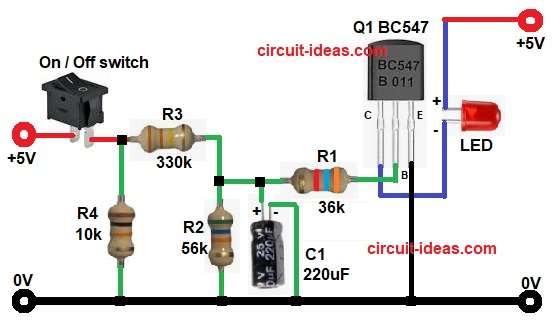
The circuit works at 5 volt power supply and uses a resistor capacitor network, then R2 and C1 make timing where voltage on capacitor slowly increases.
When capacitor voltage increases then base of transistor Q1 gets voltage through R1 and then transistor starts to turn ON slowly and LED glows bright slowly.
When power is OFF or capacitor discharges then voltage falls slowly and transistor switches OFF slowly and LED fades slowly.
After that, R3 and R4 create small voltage supply for charging capacitor and then R1 limits base current of transistor as Q1 is NPN BC547 which controls LED current.
Formula:
Formula for charging time constant:
tau = R x C
where,
- tau means time constant of the RC circuit.
- R is R2 the charging resistor in series with the capacitor
- C is C1 the electrolytic capacitor that stores charge
How to Build:
To build a Simple Up Down Fading LED Circuit follow the below steps:
- First, take all the parts as shown in circuit diagram.
- Next, transistor Q1 emitter goes to ground, collector goes to LED negative terminal and LED positive terminal goes to positive supply and base goes to junction of R1 and capacitor C1 positive.
- Then capacitor negative pin goes to ground.
- Now R2 goes between capacitor C1 positive pin and GND and R4 goes between switch and resistor R3 and GND.
Conclusion:
To conclude, this is very Simple Up Down Fading LED Circuit, which uses resistors and capacitor timing and transistor gives smooth brightness change.
Also, it is good for learning RC circuits and is easy to expand for many LEDs by using more transistors.