
A Walkie Talkie Circuit is a small communication device that allows two people to talk without wires, and it works using radio signals over a short distance.
Furthermore, one person can talk while the other listens, but both cannot communicate at the same time; additionally, this project is useful for fun, short-range communication and learning basic electronics concepts.
Circuit Working:
Parts List:
| Components | Values | Quantity |
|---|---|---|
| Resistors (All resistors are 1/4 watt unless specified) | 10k | 2 |
| 5.6k | 1 | |
| 22Ω | 1 | |
| 680Ω | 1 | |
| 8.2k | 1 | |
| 3.3k | 1 | |
| Capacitors | ||
| Ceramic 15pF | 1 | |
| Ceramic 1nF | 1 | |
| Ceramic 27pF | 1 | |
| Ceramic 47pF | 1 | |
| Ceramic 100pF | 1 | |
| Ceramic 4.7pF | 1 | |
| Ceramic 47nF | 1 | |
| Ceramic 22nF | 1 | |
| Ceramic 100nF | 1 | |
| Electrolytic 10µF 25V | 1 | |
| Electrolytic 100µF 25V | 2 | |
| Semiconductors | IC LM386 | 1 |
| Transistor BC547 | 1 | |
| Electret Mic | 1 | |
| Antenna Coil As specified | 1 | |
| 22uH Choke | 1 | |
| Antenna | 1 | |
| 8Ω Speaker | 1 | |
| ON/OFF Switch | 1 | |
| Selector Switch | 4 | |
| Battery 6V | 1 |
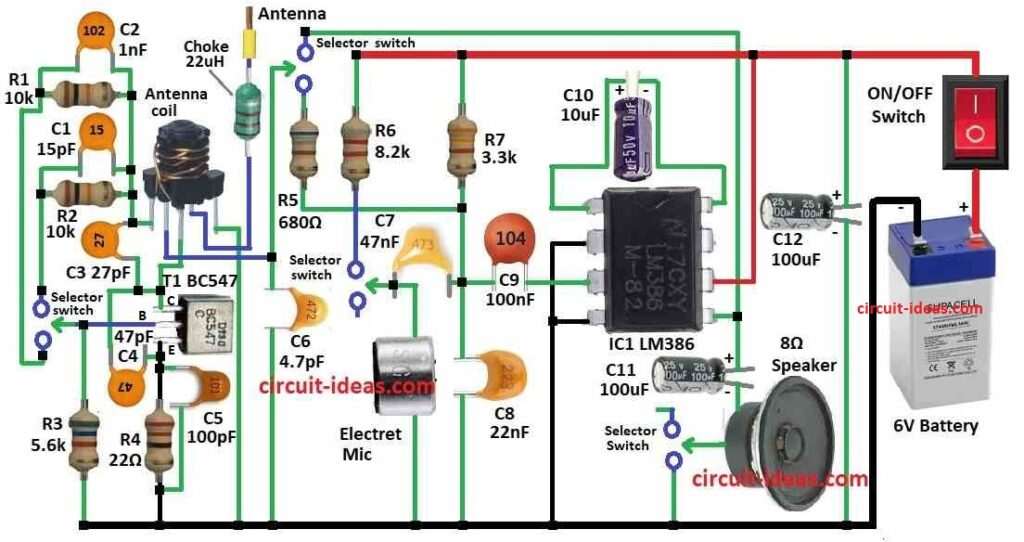
To begin with, this is simple walkie talkie circuit, which uses one IC called LM386 and this IC is small audio amplifier which uses low power.
How it work:
First, the microphone (mic) captures sound and converts it into an electrical signal.
Next, the BC547 transistor and resistors R1, R2, and R3 amplify the signal and finally, the switch selects the operating mode, allowing the user to either talk or listen.
In Talk Transmit Mode:
The switch sends the signal to the coil (antenna) and the coil then generates electromagnetic waves that carry the signal.
Furthermore, the signal strength depends on the current supplied by the amplifier.
In Listen Receive Mode:
When receiving a signal, the switch connects the coil to the circuit.
The coil then captures radio signals from another walkie-talkie; additionally, capacitor C3 helps tune the signal and reduces unwanted noise.
Next, the signal goes to the LM386 amplifier IC, which increases the audio level and finally, the speaker reproduces the sound so that the user can hear it clearly.
Switch button control talk or listen:
Press to talk and release to listen, as this circuit is simple and work only at short distance means few meters.
How to Make Antenna Coil:
Coil is very important and connect coil to transistor BC547.
Use small slug 3mm wide with 7 to 10mm tall and then use thin copper wire from 0.3mm to 0.5mm.
Winding Coil:
First, wind 4 turns on the slug to form the primary coil, then, wind 2 additional turns on top of the primary coil to create the secondary coil.
Next, after making 1 turn of the secondary coil, bring out a wire to create a tap and connect it to capacitor C6.
Formulas:
Walkie talkie circuit frequency depend on many things and its main part is oscillator which make steady carrier signal.
Two common types:
LC oscillator uses coil and capacitor and crystal oscillator uses crystal for steady signal
Use this formula:
f = 1 / 2π√LC
where:
- L is coil inductance in henry H
- C is capacitor capacitance in farad F
- f is frequency in hertz Hz
This formula can tell how coil and capacitor set the frequency.
Extra Information (Optional):
Some circuits use a PLL (Phase-Locked Loop) and a reference oscillator because they provide a stable and accurate frequency.
Additionally, they support operation across multiple channels more effectively.
However, the frequency still depends on the oscillator type and the values of the coil and capacitor.
Therefore, understanding the LC formula helps explain how the circuit sets the basic frequency.
How to Build:
To build a Walkie Talkie Circuit we need to follow the below mentioned components connections steps:
- First, connect pin 1 and 5 of IC LM386 with capacitor C10.
- Next, connect pin 2 and 4 of IC to ground.
- Then connect pin 3 of IC with capacitor C9.
- After that, connect pin 5 also to capacitor C11, 8 ohm speaker and selector switch and then to ground.
- Now connect pin 6 to positive power of 6V.
- Connect emitter of T1 BC547 to ground with resistor R4, connect base of transistor to selector switch and then connect collector to one side of antenna coil.
- Also, mic has one side to capacitor C7 and other side to ground.
- ON/OFF switch goes to positive side of 6V battery.
- Lastly, antenna coil connects to 22uH choke and antenna and one side of antenna coil also connect to capacitors C1, C2, C3 and resistors R1, R2.
Note:
- Be careful while working with electronics, as we must need some basic electronics and soldering skills.
- Also, check local laws before using the circuit, as authorities may regulate radio signals in your area.
- Furthermore, ensure that our operation complies with all applicable regulations.
Conclusion:
Overall, this Walkie Talkie Circuit is simple and fun project, as it is good for learning radio and circuit basics.
Moreover, it is not for long distance or two-way talk at same time, but it is for short range as it is a good beginner project.