This Mini Condenser Microphone Amplifier Circuit is low cost project.
It helps condenser mic give clear output by making weak mic sound more strong.
It improves voice signal from condenser mic and gives circuit a good audio gain.
The circuit works with small 9V battery supply and no IC is needed in this design.
Anyone can build this at home and it is best for beginners learning audio electronics.
Circuit Working:
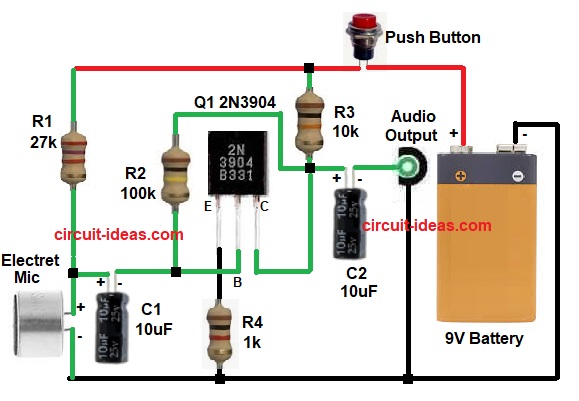
Parts List:
| Components Type | Value | Quantity |
|---|---|---|
| Resistors ( All resistors are 1/4 watt) | 27k, 10k, 100k, 1k | 1 each |
| Capacitors | Electrolytic 10uF 25V | 2 |
| Semiconductors | Transistor 2N3904 | 1 |
| Electret Condenser Mic | 1 | |
| SPST Switch | 1 | |
| 9V Battery | 1 |
The condenser microphone converts sound into small electrical signal.
R1 provides bias voltage to the microphone.
C1 blocks DC and passes only audio signal to transistor base.
Q1 works as a common emitter amplifier.
R2 gives feedback and stabilizes gain and R3 acts as collector load resistor.
R4 sets emitter current and stabilizes transistor operation.
The amplified signal appears at the collector of Q1.
C2 blocks DC and sends audio signal to output and this output can be connected to amplifier or recorder.
How to Build:
To build a Mini Condenser Microphone Amplifier Circuit follow the below connection steps:
- Q1 base pin connect to C1 negative and R2 one side.
- Q1 collector pin connect where R2, R3 and C2 positive meet.
- Q1 emitter pin connect to R4 and ground.
- R1 one side connect to 9V positive and R1 other side connect to MIC positive.
- R2 one side connect to Q1 base and R2 other side connect to Q1 collector.
- R3 one side connect to 9V positive through switch S1 and R3 other side connect to Q1 collector.
- R4 one side connect to Q1 emitter and R4 other side connect to ground.
- C1 positive connect between MIC positive and R1 and C1 negative connect to Q1 base.
- C2 positive connect to Q1 collector and C2 negative connect to output.
Conclusion:
This is easy Mini Condenser Microphone Amplifier Circuit.
It uses minimum components and low cost parts.
The circuit gives good gain for condenser microphone.
It is useful for audio projects and experiments.
Beginners can easily build and test this circuit.

Leave a Reply