
Plant need water but many time we forget, so for this problem we have made a Simple DIY Automatic Plant Watering Circuit
Here the project uses soil sensor, small pump, MOSFET and some parts, then the system checks soil wet or dry and pump start only when soil is dry.
Moreover, the circuit is very easy with no Arduino and with no microcontroller needed.
Circuit Working:
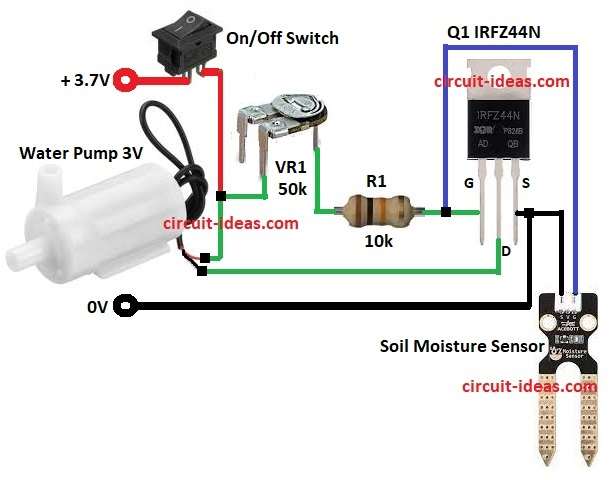
Parts List:
| Components | Values | Quantity |
|---|---|---|
| Resistors | 10k 1/4 watt | 1 |
| Preset 50k | 1 | |
| Semiconductors | MOSFET IRFZ44N | 1 |
| Water Pump 3V DC Mini Pump | 1 | |
| Soil Moisture Sensor | 1 | |
| Battery 3.7V Li-ion / LiPo | 1 | |
| On/Off Switch | 1 |
To begin with, the soil moisture sensor is the main component of this circuit.
The sensor checks whether the soil is wet or dry and then dry soil creates high resistance between the sensor probes.
Hence, this gives voltage to MOSFET gate and then MOSFET IRFZ44N act like electronic switch; then high sensor output turns ON MOSFET and pump start and wet soil gives low signal and pump stops.
After that, preset VR1 set sensitivity of soil detect and 10k resistor keep MOSFET gate stable.
Formula:
Formula for automatic plant watering circuit is below:
Soil resistance changes with water and dry soil has high resistance in kilo ohm and wet soil has low resistance in hundreds of ohm.
Use Ohm law: V = I * R.
Sensor give 2.5V in dry with 0.5V in wet and MOSFET gate need 2 to 4V to turn ON.
Dry soil with voltage high makes MOSFET ON and pump work from 3.7V battery and then pump take 100 to 300mA current.
Also, a 10k resistor make gate 0V when there is no signal.
How to Build:
To build a Simple DIY Automatic Plant Watering Circuit follow the below steps for connections:
- First, take all the parts as mentioned in the circuit diagram above.
- Next, soil sensor two pins go to MOSFET gate and source.
- Then preset one side go to 3.7V positive with pump and other side to 10k resistor and MOSFET gate.
- Also, pump other side connect to MOSFET drain and MOSFET source connect to soil sensor one pin and GND.
- After that, soil sensor other pin go to MOSFET gate.
Conclusion:
To conclude, this project for Simple DIY Automatic Plant Watering Circuit is very simple and with very low cost.
Here, the circuit does not use an Arduino or any coding, instead, it works with only a sensor, a MOSFET, a pump and a few resistors.
Also, it save water and keep plant good and water come only when soil is dry; so anyone can make this circuit at home with small parts and with little money.