Many a times, automobile engine heat problem has become very common, engine gets too hot and driver is not aware of it early, because of this, engine damage can happen and repair cost becomes high, so we need simple system which can give early warning.
This project shows a small and low cost heat alert circuit using LED, which checks temperature using thermistor and gives indication when heat becomes high, when temperature crosses set level, LED will glow and alert the user immediately.
This Automobile Engine Overheat Alert Circuit using LED is very easy to build and uses less components, it can be used in car, bike or any machine where temperature control is important, as It helps to protect engine and increase life of vehicle.
So, this system is simple, useful and practical for real life application.
Circuit Working:
Parts List:
| Components | Values | Quantity |
|---|---|---|
| Resistors (All resistors are 1/4 watt) | 47k, 10k, 390k, 1k | 1 each |
| Preset 47k | 2 | |
| Capacitor | Ceramic 2.2µF 50V | 1 |
| IC LM741 | 1 | |
| Any 10k NTC thermistor | 1 | |
| LED any standard | 1 | |
| Battery 12V | 1 |
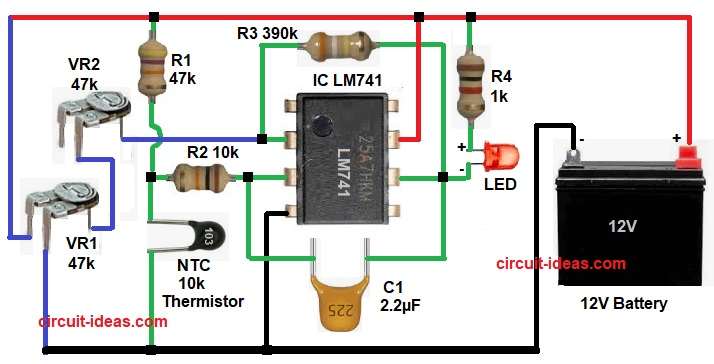
In this circuit, thermistor senses temperature with thermistor resistance decreases when temperature increases and this change in resistance changes voltage at input of op-amp.
Pin 3 of LM741 gets voltage from thermistor through resistor R2 and pin 2 gets reference voltage from voltage divider made using VR1, VR2 and R1.
User can adjust VR1 and VR2 to set desired temperature level and when temperature is normal, voltage at pin 3 stays lower than reference voltage at pin 2 and output at pin 6 stays low and LED remains OFF.
When temperature increases, thermistor resistance drops, voltage at pin 3 increases and when this voltage becomes higher than reference voltage at pin 2, op-amp output goes HIGH.
High output from pin 6 allows current to flow through LED and resistor R4 and then this LED glows and gives warning signal.
Capacitor C1 helps to stabilize output and avoid flickering of LED.
How to Build:
To build a Automobile Engine Overheat Alert Circuit using LED following are the connection steps one needs to follow:
- Start, the circuit by collecting all the parts as in circuit diagram above.
- Then start with IC pin 2 inverting input and connect to reference voltage divider.
- Pin 3 is non-inverting input and connect to one end of thermistor network through resistor R2.
- Pin 4 V- connect to ground.
- Pin 6 output, connect to cathode of LED and anode of led goes to resistor R4 and positive supply of 12V.
- Pin 7 positive supply, connect to +12V supply.
- Thermistor connect between input node and ground.
- R1, VR1, VR2 make voltage divider for reference.
- R2 connect between thermistor node and pin 3.
- R3 feedback resistor connect between pin 2 and pin 6 of IC.
- C1 connect between pin 3 and pin 6 of IC.
- LED and R4 resistor connect in series from pin 6 of IC and positive supply.
- Finally, connect battery +12V to positive supply of the circuit and battery negative to main common GND of the circuit.
Conclusion:
This Automobile Engine Overheat Alert Circuit using LED gives simple and effective heat warning system for automobile, which detects temperature rise and turns ON LED.
User can adjust sensitivity using variable resistors, as this design uses few components and works reliably and it helps to protect engine from overheating damage.

Leave a Reply