Simple Mobile Phone Signal Jammer Circuit is device that stop signal between phone and tower, it does this by using same radio frequency like phone and to make communication not to work.
Also, this small circuit can block call and message on 3G, 4G and also old network.
Here, three main part inside jammer are:
First is the amplifier which make signal more strong.
Second one is special circuit which creates right type radio waves.
Third the device then modifies these waves so they can interfere with the phone signal and when all the parts work together, they jam the phone signal.
WARNING: In many countries jammers are illegal to use, sell or make and using jammer can cause fine or jail in some places.
Emergency services such as ambulances and police require clear communication signal, and this jammer circuit can interfere with them.
Therefore, only government agencies such as the military or police are sometimes permitted to use such devices.
Circuit working:
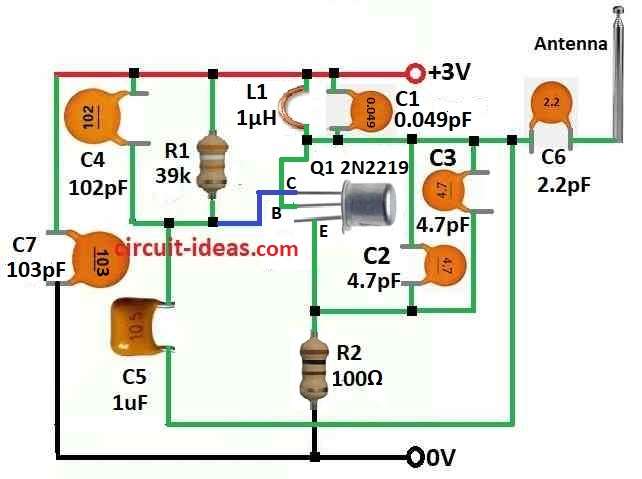
Parts List:
| Components | Quantity |
|---|---|
| Resistors (All resistors are 1/4 watt) | |
| 39k | 1 |
| 100Ω | 1 |
| Capacitors | |
| Ceramic 0.049pF | 1 |
| Ceramic 102pF | 1 |
| Ceramic 1uF | 1 |
| Ceramic 2.2pF | 1 |
| Ceramic 103pF | 1 |
| Ceramic 4.7pF | 2 |
| Semiconductors | |
| Transistor 2N2219 | 1 |
| Inductor 1uH | 1 |
| Antenna | 1 |
RF amplifier circuit have transistor Q1, capacitors C4, C5 and resistor R1.
Also, this circuit make signal from tuned circuit which is more strong and then signal goes to antenna by capacitor C6 and this C6 stop DC but let AC go.
When transistor Q1 turns ON, tuned circuit at collector also start working and this tuned circuit have capacitor C1 and inductor L1 which works like oscillator with very small resistance to make very high frequency.
Furthermore, this happen because capacitor charges and discharges again and again and it also make oscillation but after some time small resistance come and stop oscillation.
Before C6, the tuned circuit boosts and mixes the frequency with noise from capacitors C2 and C3.
The RF amplifier then sends power to the collector through capacitor C5, producing a strong combined signal for transmission.
Here, mobile phones use different frequency bands in world and to make jammer circuit we have used one formula to find correct values.
Value of inductor L1 and capacitor C1 can change depending which frequency we want to block.
Example, if phone in area use 450 MHz then jammer also make 450 MHz with noise, hence, this confuses the phone and it cannot catch right signal.
Note : This circuit only work around 100 meter distance.
Important: Also using this circuit is illegal in most countries, so remember this information is only for learning not for any misuse.
Formula:
Resonant frequency (F) of simple LC circuit we find by this formula:
F = 1 / (2 × π × √(L1 × C1))
where:
- F is frequency in hertz Hz which shows max oscillation of circuit.
- π (pi) is math value which is about 3.14159.
- L1 is inductor value in Henrys H where inductor stops fast to change in current and store energy in magnetic field.
- C1 is capacitor value in farads F where capacitor store electric energy in electrostatic field.
About the Formula:
This formula connect inductance L1 and capacitance C1 to find frequency.
In LC circuit when inductor and capacitor gives same opposite reactance it make resonance, hence, this means inductors reactance XL and capacitors reactance XC cancel each other.
Square Root Part (√(L1 × C1)):
This show how much inductor and capacitor affect circuit together and at resonance this effect becomes zero.
2π Factor:
We use 2π to convert reactance into frequency because, in AC circuits, frequency and reactance are directly related.
In simple words:
Therefore, this formula tell what frequency LC circuit will resonate and it happen when inductor and capacitor balance each others effect.
Conclusion:
To conclude, many countries prohibit this Simple Mobile Phone Signal Jammer Circuit because it can block important communication and emergency calls.
Lastly, they also make trouble for other people using phone in legal way nearby and also making jammer at home is also not legal, even for fun or learning.
So it is very important to build or use this kind of device as it against the law.

where can i get 0.05pf capacitor?
Hi peter,
Use 0.047µF 50V (47nF) capacitor, Because of tolerance (±5% or ±10%), its actual value may be close to 0.050µF anyway OR If you really want closer to 0.050µF then you can connect capacitors in parallel: 0.047µF + 0.0033µF = 0.0503µF, this is only what i can guide you with.
Note: In almost every country, operating or even building a signal jammer is highly illegal and can result in heavy fines or jail time because they interfere with emergency services, so i hope you are not breaking any laws as per your government norms. Thanks.
can i use a 9v battery with the signal jammer?
does that effect the values ?
Hi peter,
thanks for your comment, below is my idea about your query:
Yes, you can use 9V but you must change some parts. Here is what happens and what to change:
1.The Heat Problem (Resistors)The original circuit uses 3V. If you use 9V, the current becomes 3 times stronger.R1 (100R) this will get very hot. You should change it to a higher value, like 330Ω or 470Ω, to protect the transistor Q1. R2 (39k): This controls the base of the transistor. For 9V, you might need a higher value (like 100k) so the transistor stays in the right mood to oscillate.
2. Transistor Q1 the 2N2219 is strong, but at 9V it will work harder, it will get hot, use a small metal heat sink on the transistor so it does not burn out.
3. Frequency Capacitors does it effect the values? Yes, a little the frequency (the jamming signal) depends on the voltage. If you change 3V to 9V, the tuning might shift. The capacitors (C1, C2, C3) do not need to change their capacity value, but they must be rated for at least 16V or 25V rest of the ceramic capacitors are fine.
But note using mobile signal jammer is illegal in many countries. It can block emergency calls and is dangerous. Please check your country law before making, testing or modifying it.
i cannot find a 0.05pf capacitor anywhere
Hi peter,
Use 0.047µF 50V (47nF) capacitor, Because of tolerance (±5% or ±10%), its actual value may be close to 0.050µF anyway OR If you really want closer to 0.050µF then you can connect capacitors in parallel: 0.047µF + 0.0033µF = 0.0503µF, this is only what i can guide you with.
Note: In almost every country, operating or even building a signal jammer is highly illegal and can result in heavy fines or jail time because they interfere with emergency services, so i hope you are not breaking any laws as per your government norms. Thanks.
i`ve tried this cicuit–it doesn`t work.
Phuff… where is to start.
1. With L1 (22mH) and C1 (15pF), oscillant strikes 277 kHz – nowhere to count mobile phone channel.
2. BF494 transister has max-out frequently of 120 MHz – nochance of making mobile phone channel.
3. R2 (100K) mean current of 0.01 mW for power-out no more than 30 nW in highlight. Insufficience for any jambling pweor.
4. C7 and C5 value should swamp otherwise killing of oscailliert.
Whole circuit will never fire any chance of work.
thank you for your suggestion, I have updated the changes accordingly.