
One tool for checking static electricity is Electroscope Circuit to Measure Electrostatic Charge.
Static electricity happen when object have unbalanced electric charges and electroscope help to know if static electricity is there and it is how much; as it is just simple conductor.
Also, when something touches it, then electroscope charge changes and react and this movement show what charge was before.
Circuit Working:
Parts List:
| Components | Values | Quantity |
|---|---|---|
| Resistors | 100k 1/4 watt | 2 |
| 10k 1/4 watt | 1 | |
| R4 (2 to 20k range) | 1 | |
| Capacitors | Ceramic C1 (1 to 2μF range) | 1 |
| Electrolytic 1μF 16V | 1 | |
| Semiconductors | IC MAX 4322 | 2 |
| ON/OFF Switch | 1 | |
| Meter 100uA center 0 | 1 |
To begin with, this DIY electroscope circuit help to find electrostatic charge properly.
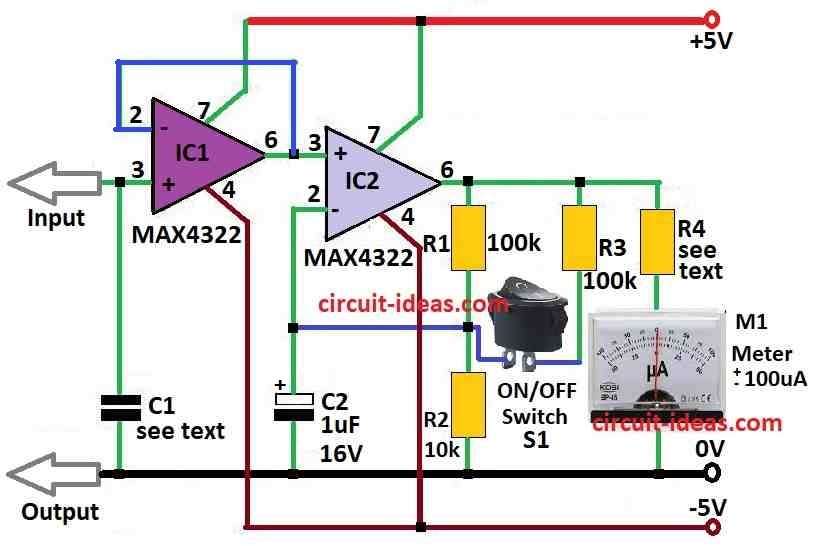
Here, capacitor C1 is good MKT capacitor and its value is from 1 to 2μF which keep the charge we want to measure.
Formula is U = Q / C1.
Above formaula tells how voltage U and charge Q are related in capacitor C1 and this high resistance part is safe because operational amplifier IC2 protect it.
Also, one side of capacitor C1 connects to the input wire with the test probe, while the other side connects to the ground wire, which serves as the ground point.
Furthermore, IC2 gives power to meter M1 (±100 μA to ±1 mA center zero) it make low voltage from IC1 stronger.
Switch S1 provides two measurement options: when S1 is open, the gain is 5 and when S1 is closed the gain becomes 10.
Meter M1 has an internal resistance of 2.2k; resistor R4, which ranges from 2k to 20k, is unnecessary when using a digital multimeter instead of M1.
Lastly, this circuit uses MAX 4322 operational amplifiers from Maxim and these op-amps can work from one rail to other and output can go to power level with normal input voltage.
Formula:
Maxim Integrated made the MAX4322 low-noise op-amp for applications that require high accuracy and low noise.
Moreover, many people use MAX 4322 in amplifier circuits where noise must be low like voltage follower.
Hence, to make MAX 4322 detect electrostatic charge we connect it as high impedance buffer to the electroscope sensitive parts.
Therefore, when using MAX 4322 for measuring electrostatic charge we must remember this is just a simple formula:
Av = Voltage Gain
MAX 4322 can work as unity gain amplifier or voltage follower and in this setup voltage gain Av is around 1.
Input and Output Resistance:
MAX 4322 is good for high impedance sensors or electrodes because input impedance is very high which is in hundreds of megaohms and output impedance is low so we can connect to other stages easily with no problem from loading.
Power Supply Voltage:
Always be sure MAX 4322 gets correct power from VCC which is often ±15V but depends on what we do.
Noise Point:
In electroscope circuit where we measure small electrostatic charge or weak signals MAX 4322s low noise is very important.
Formula for voltage follower mode:
Input voltage (Vin) is almost same as output voltage Vout and Av gain is close to 1.
Important Note:
When used as high impedance buffer MAX 4322 can follow and boost electrostatic charge signals from electroscope sensor; because of high input impedance and low noise it work very well for this.
How to Build:
To build a Electroscope Circuit to Measure Electrostatic Charge follow the below steps for connections:
Prepare Components:
- First, collect all parts we need like in the circuit diagram and also check all values of resistors, capacitors and other parts and be sure they are same like in diagram.
Connect IC1 and Capacitor C1:
- Next, one side of capacitor C1 connect to input wire with test probe and other side of C1 goes to ground wire and ground point.
- After that, IC1 work as buffer for high impedance source and connect output of IC1 to input of IC2.
Digital Multimeter:
- Also, if using M1 meter then connect it to circuit which will have 2.2k internal resistance and if using digital multimeter instead then there is no need of resistor R4.
Switch S1 with Range of Measurements:
- Switch S1 lets us select between two ranges: closing S1 sets the gain to 5 and opening S1 sets the gain to 10.
Verify Connections Again:
- Now check all wires and parts again and ensure they are same like in schematic.
- Then turn ON the circuit and use safe electrostatic source to test it.
Modifications:
- Use digital multimeter to adjust and get better reading if needed.
Adjusting:
- Change the circuit a little if needed and check if M1 meter show correct value.
Complete the Circuit:
- Finally, after all components are working fine put all parts in proper place and make all connections final.
Conclusion:
To conclude, this Electroscope Circuit to Measure Electrostatic Charge helps in study of physics and electronics to measure electrostatic charge.
Finally, remember the design may change in different circuits.