
In this article, the Sound to Light Converter Circuit changes sound into light, as a result, it listens to music and makes the lights flash in sync with the beat.
Furthermore, smart components inside the circuit convert changes in sound volume or pitch into variations in light brightness or flashing speed.
Circuit Working of Sound to Light Converter Circuit using Piezo:
Parts List:
| Components | Values | Quantity |
|---|---|---|
| Resistors | 1M 1/4 watt | 1 |
| 10k 1/4 watt | 2 | |
| 33k 1/4 watt | 2 | |
| Capacitors | Electrolytic | |
| 10µF 25V | 2 | |
| Semiconductors | Transistor BC547 | 2 |
| Transistor BC557 | 1 | |
| LED Red 5mm 20mA | 1 | |
| Piezo | 1 |
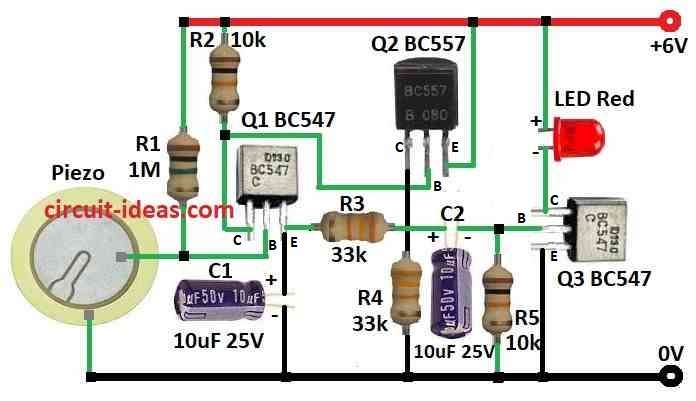
To begin with, this is sound to light circuit which uses 3 transistors to make weak sound signal strong and turn LED light ON.
Here, piezo changes sound to electric signal and transistor Q1 first amplifiers make weak sound signal strong.
Then capacitor C1 block DC and let AC sound go in and resistor R1 give proper current to Q1.
Now capacitor C2 sends signal from Q1 to Q2 and blocks DC and passes AC and then transistor Q2 second amplifier makes signal more strong.
Therefore, resistor R3 gives proper current to Q2 and resistor R4 and R5 make voltage divider and sets switch level for Q3.
Now transistor Q3 is a rectifier and it change AC signal to pulse DC and when signal is strong Q3 allow current to LED.
Hence, LED light up with sound, with more sound more light.
How to Build Sound to Light Converter Circuit using Piezo:
To build a sound to light converter circuit using piezo follow the steps:
- First, Q1 collector goes to positive through resistor R2, Q1 base connect to piezo and then Q1 emitter goes to ground through capacitor C1.
- Then Q2 collector goes to ground through resistor R4, Q2 base connect to Q1 collector and then Q2 emitter goes to positive.
- After that, Q3 collector goes to positive through red LED, Q3 base connect to Q1 emitter through resistor R3 and then Q3 emitter goes to ground.
Circuit Working of Sound to Light Converter Circuit using Electret Mic:
Parts List:
| Components | Values | Quantity |
|---|---|---|
| Resistors (All resistors are 1/4 watt unless specified) | 10k | 2 |
| 470Ω | 2 | |
| 1M | 1 | |
| 4.7k | 1 | |
| Capacitors | Ceramic 100nF | 1 |
| Semiconductors | Transistor BC547 | 2 |
| Transistor BC557 | 1 | |
| LED Red 5mm 20mA | 1 | |
| Electret Mic | 1 |
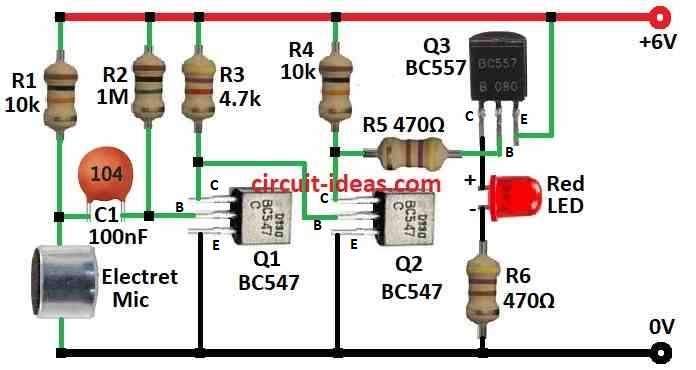
To begin with, this is sound to light circuit using electret mic and this electret mic change sound to small AC voltage.
So signal is weak and it needs amplifier to make strong for LED.
Moreover, Q1 and Q2 amplifier are for common emitter which make weak signal strong and Q3 is the emitter follower which gives more gain and changes high to low impedance for LED.
Then capacitor C1 blocks DC and only passes AC sound signal and it stop power supply DC from going to mic.
Resistors R1 to R6 set gain and bias for transistors and R1 is the bias current for Q1 and R2 & R3 are the voltage divider for Q1 base.
R4 is the bias current for Q2 and R5 is the voltage for Q2 base and R6 limit current for LED, in which LED is output.
Finally, more sound is more LED brightness.
Formulas:
To make amplifier for electret mic we need to understand transistor amplifier basics.
Transistor Amplifier with Common Emitter:
We can calculate the voltage gain (Av) using the following formula:
Av = –RC / re
where:
- RC is resistor at collector
- re is small internal resistance at emitter
This help to design simple mic amplifier and use formula to choose correct resistors and we can get the needed gain.
How to build Sound to Light Converter Circuit using Electret Mic:
To build a Sound to Light Converter Circuit using Electret Mic follow the below mentioned steps:
- First, Q1 collector goes to positive through R3, Q1 base connect to C1 and then Q1 emitter goes to ground
- Next, Q2 collector goes to positive through R4, Q2 base connect to Q1 collector and then Q2 emitter goes to ground
- Then Q3 collector goes to ground through red LED and R6 in series, Q3 base connect to Q2 collector through R5 and then Q3 emitter goes to positive of 6V battery
- Now connect mic and R1 in series from positive to ground
Note:
- Be careful! making circuits can be risky and if anyone is new to electronic then learn well and stay safe before trying.
Conclusion :
Overall, Sound to Light Converter Circuit changes sound into light and this circuit is fun way to learn electronics.
Therefore, simple ones flash with sound and big ones can make cool light shows or help people; so now take tools and see sound in new way!