
Many devices use Ni-Cd batteries because they provide good energy storage and can be recharged; however, normal charging is slow and inefficient and it can reduce battery life.
To fix this, we design an Advanced Ni-Cd Battery Fast Charging Circuit using the MAX712 chip, also this charger provides fast, safe and reliable charging for Ni-Cd batteries.
Also, this article will explain circuit design, building, working and calculations behind it.
Circuit Working:
Parts List:
| Components | Values | Quantity |
|---|---|---|
| Resistors (All resistors are 1/4 watt unless specified) | 22k | 1 |
| 68k | 1 | |
| 220Ω | 1 | |
| 470Ω | 1 | |
| 150Ω | 1 | |
| 1Ω 1W | 1 | |
| Capacitors | Ceramic 0.01µF | 1 |
| Ceramic 0.1µF | 1 | |
| Electrolytic 1µF 25V | 1 | |
| Electrolytic 1000µF 25V | 1 | |
| Semiconductors | IC MAX712 | 1 |
| PNP Transistor 2N2907 | 1 | |
| Diode 1N4007 | 5 | |
| LED 5mm, 20mA | 1 | |
| Ni-Cd Battery | 2 |
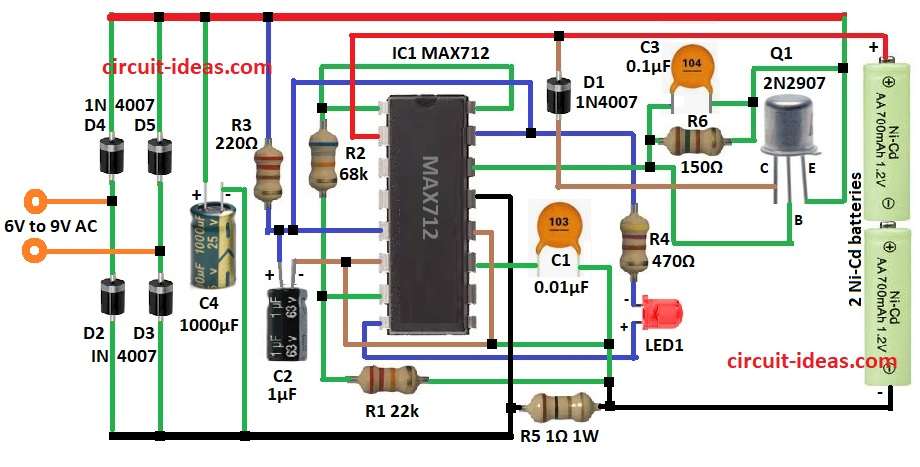
The fast Ni-Cd charger circuit has some main parts working together, it uses a bridge rectifier, voltage regulator, MAX712 chip and power transistor.
First, AC input from 6V to 9V comes in and turns into DC which is good for charging Ni-Cd batteries.
Then diodes from D2 to D5 a bridge rectifier change AC to DC and after that capacitor C4 1000µF smooths the DC and removes bumps.
Now MAX712 IC chip controls charging and checks voltage and current by stops overcharging; charging time and working depend on resistor R1 and capacitor C2.
Then LED1 shows if battery is charging and power transistor Q1 controls charging current and lastly, resistors R5 and R6 help manage current to battery pack.
Formulas with Calculations:
To make our own Ni-Cd fast charger then we can use these formulas:
Charging Current (Icharge):
Icharge = Vout / R
where,
- Vout is the output voltage
- R is the current limiting resistor
Charging Time (Tcharge):
Tcharge = (1.4 × Cbattery) / Icharge
where,
- Tcharge is the time in hours
- Cbattery is the battery capacity in mAh
- Icharge is the charging current in mA
Example:
Battery = 1000mAh and Icharge = 500mA
Tcharge = (1.4 × 1000) / 500 = 2.8 hours
Power Loss in Resistor (P):
P = I² × R
Example:
I = 0.5A, R = 1Ω
P = (0.5)² × 1 = 0.25W
So use a 1W resistor for safety.
How to Build:
To build a Advanced Ni-Cd Battery Fast Charging Circuit follow below steps for connections:
- First, gather all parts shown in the circuit diagram.
- Next, connect pin 1 of MAX712 IC1 to pin 16.
- After that, pin 2 goes to positive side of Ni-Cd battery.
- Now diode D1 cathode connects to pin 2 and anode to collector of Q1.
- Also, pin 5 connects to pin 15 and then resistor R3 connects from positive supply to pin 5.
- Further, pin 6 connects to pin 12.
- Then pin 7 goes between R2 and R1 and R2 connects from pin 16 to pin 7 and also R1 connects from pin 7 to one side of C1.
- Now pin 8 connects to pin 15 through LED1 and resistor R4.
- Pin 11 connects to C1 and R2 and pin 13 goes to GND.
- Also, pin 14 goes to base of Q1, Q1 collector goes to pin 2 via D1 and emitter goes to positive supply.
- Next, connect C3 and R6 in parallel between pin 14 and positive supply and battery positive connects to pin 2 and negative connects to pin 6.
- Then R5 goes from negative of battery to GND and C2 positive connects to pin 15 and negative to other side of R1.
- After that, C4 positive goes to positive supply and negative to GND.
- Diodes D2 to D5 make bridge rectifier and their positive sides to positive supply and negative sides to negative supply.
- Finally, connect 6V to 9V AC to bridge rectifier input.
Conclusion:
Overall, this Advanced Ni-Cd Battery Fast Charging Circuit charges batteries fast and safe also there is no long wait as the battery lasts longer.
Therefore, we can change charge speed and time for different battery sizes, as this circuit is great for hobby people, DIY lovers and for backup power needs.