
To begin with, this 3V LED Driver Circuit using IC LT1937 is a compact LED driver because it uses the LT1937 IC, which can power a white LED from only a 3V battery.
Furthermore, the IC takes a low input voltage and boosts it to the level required by the LED.
As a result, the circuit works well for mobile lights, small torches and display backlights, in addition, it saves power and provides stable, bright light.
Block Diagram:
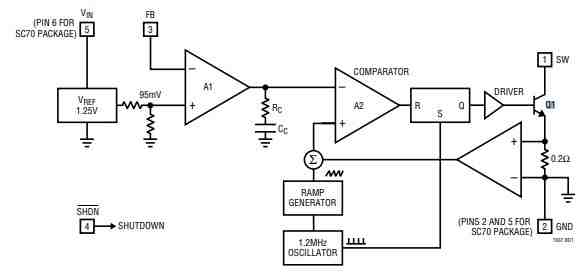
See block diagram to know how circuit works.
The LT1937 keeps the power output stable through its control system.
Switch Q1 turns ON during each cycle and then, the circuit monitors the current, adds a ramp signal and sends the combined signal to A2 and if the signal becomes too large, A2 turns OFF the switch.
Meanwhile, A2 works together with A1, and A1 compares the feedback voltage with a 95 mV reference.
As a result, a high output from A1 increases the output current, while a low output from A1 decreases the output current.
Circuit Description:
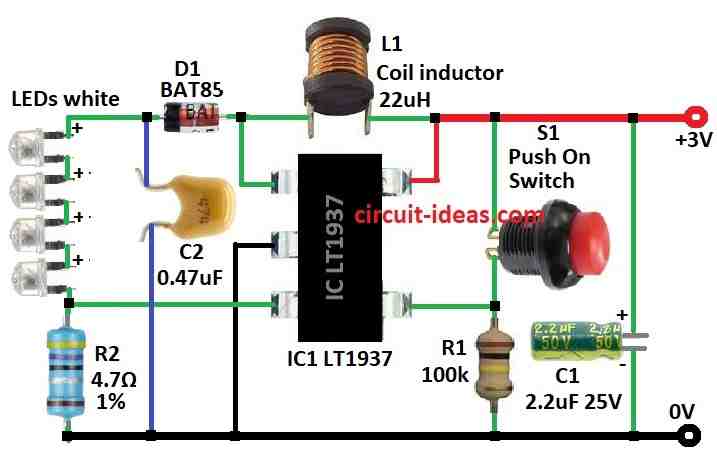
Parts List:
| Components | Values | Quantity |
|---|---|---|
| Resistors (All resistors are 1/4 watt unless specified) | 4.7Ω 1% | 1 |
| 100k | 1 | |
| Capacitors | Ceramic 0.47µF | 1 |
| Electrolytic 2.2µF 25V | 1 | |
| Semiconductors | IC LT1937 | 1 |
| Diode BAT85 | 1 | |
| Straw hat white LEDs 5mm | 4 | |
| Coil inductor 20uH | 1 | |
| Push on switch | 1 |
LT1937 can drive 4 LEDs in series from 4.2V battery with 4mA current and at 4mA there is no pulse so skip if circuit made for 15mA.
Also, if current is low then pulses skip and small ripple come, average current is still stable with even near to zero.
Use a low-resistance 22 µH inductor for 1.2 MHz operation; also, use X5R or X7R ceramic capacitors, such as a 2.2 µF capacitor for C1 at the input and a 0.47 µF capacitor for C2 at the output.
Use a fast Schottky diode with a low voltage drop to reduce power loss.
Also, avoid diodes with high junction capacitance because they increase switching losses at 1.2 MHz; in addition, choose a diode with a current rating of about 100 to 200 mA for the best performance.
Resistor R2 sets the LED current.
Formula: Current = 95mV ÷ R1.
Use 1% resistor for accurate LED current.
Formulas and Calculations:
This formula helps set LED current using LT1937 chip.
Main formula:
R2 = 95mV / ILED
This means, the chip uses a 95mV reference voltage at the ISET pin and by choosing resistor R2 we can decide how much current flows through LED.
Rearranged formula:
ILED = 95mV / R2
Example:
We want 20mA LED current:
R2 = 0.095V / 0.02A = 4.75Ω
Pick nearby resistor: 4.7Ω or 5.1Ω
Important:
Check resistor power rating:
P = I² × R2
Ensure resistor can handle the heat with 1/4 watt is good for most cases.
Summary:
Use R2 = 95mV / ILED
This sets LED current based on internal 95mV reference of LT1937.
How to Build:
To build a 3V LED Driver Circuit using IC LT1937 follow the below mentioned steps for connection purpose:
- First, collect all parts from circuit diagram.
- Next, give correct voltage for LT1937 for that see the datasheet.
- Then connect Wire LT1937, add inductor 22µH, capacitor 2.2µF input + 0.47µF output, Schottky diode, R2 and check its polarity.
- Now test the power ON and check output voltage and LED current with load.
- After that, if required change resistor or parts if output not stable and also use good insulation, grounding and solder neat.
Conclusion:
Overall, the 3V LED Driver Circuit using IC LT1937 offers a compact solution for powering 3V LEDs from a higher input voltage.
Moreover, it keeps the LED brightness steady and consistent, making it a good choice for many LED-based projects.