Acupuncture Point Locator Circuit is small device which helps to find special point on human body; in acupuncture thin needle goes inside our body part to reduce pain.
Moreover, this is old medical method and these special body points called acupuncture point or just acupoints.
People also think energy moves through body using these points, so to find these point this circuit uses electronic things.
One way is to check skin resistance, and this skin resistance on acupuncture point is usually low than other skin part.
Hence, this circuit uses a sensor that touches the skin to detect signals and the light and sound turn ON when the circuit finds a point.
Circuit Working:
Parts List:
| Components | Values | Quantity |
|---|---|---|
| Resistors | 100k 1/4 watt | 1 |
| 12k 1/4 watt | 1 | |
| 180k 1/4 watt | 1 | |
| Potentiometer 10M | 1 | |
| Potentiometer 10k | 1 | |
| Potentiometer 220Ω | 1 | |
| Capacitors | Ceramic 560pF | 1 |
| Ceramic 0.022μF | 1 | |
| Electrolytic 4.7μF 16V | 1 | |
| Semiconductors | Transistor 2N2222 | 1 |
| IC 4046 | 1 | |
| ON/OFF Switch | 1 | |
| Speaker 4Ω | 1 | |
| Battery 9V | 1 | |
| Probe (Medical) | 1 |
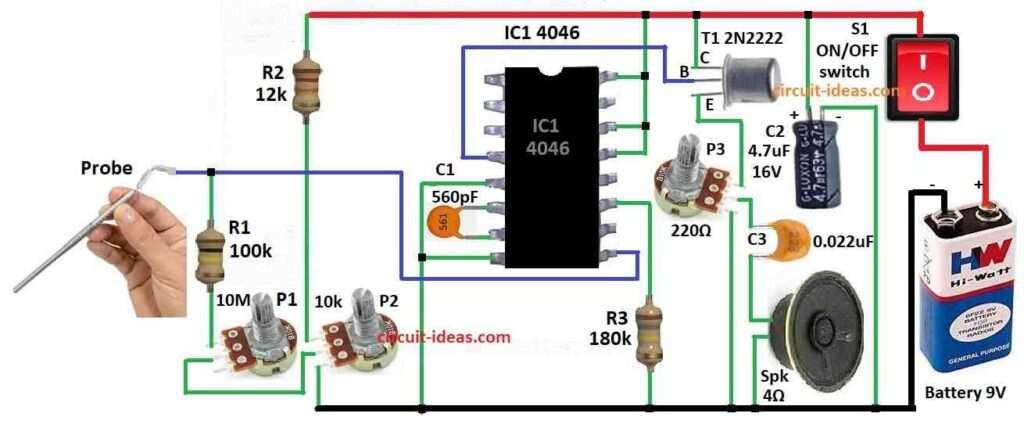
To begin with, for this the acupuncture point locator uses one electronic circuit, as it uses one chip called CD4046 and this chip is CMOS type and have VCO voltage control oscillator inside.
Here, the parts R3 and C1 control how fast the VCO work with its frequency and this changes more when control voltage change.
Furthermore, skin resistance R1 and one adjustable part P1 make control voltage using voltage divider and when skin resistance goes low the control voltage and frequency goes high.
Also, this make sound come from speaker and transistor T1 gives enough power to speaker so it can work.
Formula:
PLL ICs like the 4046 work in many applications such as FM radio circuits and frequency generation, the Acupuncture Point Finder also uses the IC 4046 in a special way.
Also, it help to find change in skin resistance or impedance at acupuncture point.
Main work of this finder is to check frequency from VCO and this frequency changes when skin resistance changes at point.
The formula is:
fout = f0 + k × R
where:
- fout is output frequency of VCO
- f0 is base frequency of VCO
- k one fixed value from circuit
- R is skin resistance
One example:
Assemble:
Electrodes touch acupuncture point with probe.
Use frequency counter to see VCO output.
Understand:
If the output frequency (fout) changes, the skin resistance also changes, which shows that the circuit has found an acupuncture point.
Also, the IC 4046 works well for this purpose because it responds to skin signals and helps build the acupuncture finder easily.
How to Build:
To build a Acupuncture Point Locator Circuit follow the below steps for connection:
- First, put CD 4046 IC on breadboard and connect pin 5 and 8 of CD4046 to ground GND.
- Next, connect pin 13, 14 and 16 to positive power VCC.
- After that, connect pin 6 and 7 with 560pF capacitor.
- Then connect pin 4 to base of transistor 2N2222 and connect emitter of 2N2222 to speaker using one potentiometer.
- Also, put one 4.7μF capacitor between positive and ground and across supply and then connect 2 potentiometer in series between probe and positive wire.
Testing:
- Next, turn ON the circuit and move potentiometer P1 slowly.
- When speaker make sound it mean circuit is working and sound will change when skin resistance change.
- Now adjust P1 and P2 to test on different skin points and listen to sound frequency go up or down.
Note:
- These steps are simple version but for more full information please check parts datasheet and also be safe with circuits and double check all wires before power ON because wrong wire can break parts.
Conclusion:
To conclude, this Electronic Acupuncture Point Locator Circuit works as a useful tool, but it cannot replace a real acupuncturist.
Moreover, Acupuncture is difficult medical work and how well it works depend on patient need and doctors skill.

Leave a Reply