
In this article, we will explain about a simple and easy 3V Battery Operated Lamp Flasher Circuit.
It is used to flash a lamp using only 3V supply.
Usually, low voltage flashing circuits give low output current.
However, this circuit gives high current output and therefore, it can drive a small lamp easily.
The heart of this circuit is LM3909 IC and it is a famous LED flasher IC.
But here, it is used in lamp flasher mode, in addition a transistor is added and because of this the output current increases a lot.
As a result, this circuit is useful for battery projects and also it is good for toys, indicators and warning lights.
Circuit Working:
Parts List:
| Components | Value | Quantity |
|---|---|---|
| Resistors | 2.2k, 100Ω | 1 each |
| Preset 5k | 1 | |
| Capacitor | Electrolytic 470uF 25V | 1 |
| Semiconductors | IC LM3909 or NE555 | 1 |
| Transistor 2N2222 | 1 | |
| Lamp 3V Mini Bulb | 1 | |
| Battery 3V | 1 | |
| SPST On-Off Switch | 1 |
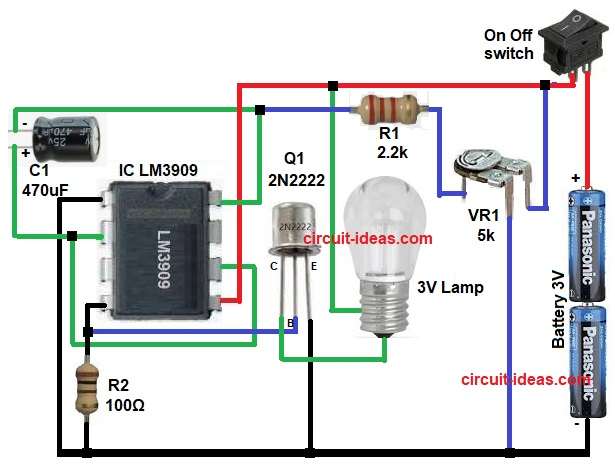
Now let us understand the circuit, the LM3909 IC works as an oscillator as it generates ON and OFF pulses and these pulses control the transistor.
First, switch S1 is turned ON and so 3V supply reaches the circuit and then capacitor C1 starts charging through R1 and VR1.
Meanwhile, LM3909 IC monitors capacitor voltage and when voltage reaches threshold the IC output changes.
As a result, transistor Q1 turns ON and so the lamp lights up brightly.
After that the capacitor discharges fast and then transistor turns OFF and therefore, lamp goes OFF.
This process repeats again and again and hence, lamp flashes continuously.
Formula with Calculation:
Flashing Time Formula:
Time = 1.1 x R x C
where,
- R is total resistance in ohms
- C is capacitor value in farads
Calculation as per circuit:
VR1 max = 5000 ohm
R1 = 2200 ohm
Total R = 5000 + 2200
Total R = 7200 ohm
C = 470uF
C = 470 x 10^-6 F
Time = 1.1 x 7200 x 470 x 10^-6
Time = 3.72 seconds
So flash interval is about 3.7 seconds and by adjusting VR1 the timing can be increased or decreased.
How to Build:
To build a 3V Battery Operated Lamp Flasher Circuit follow the below connection steps:
- First, collect all parts as shown in the circuit diagram.
- Pin 1 of the IC is connected directly to ground.
- Next, pin 2 of the IC is connected to positive side of capacitor C1.
- Then pin 4 of the IC goes to ground.
- This pin is connected through transistor Q1 base and resistor R2.
- After that, pin 5 of the IC is connected to one side of the lamp.
- This point also connects to the positive power supply.
- Pin 6 of the IC is connected to pin 2 of the IC.
- Next, pin 8 of the IC is connected to the junction of resistor R1 and preset VR1.
- Base pin of transistor is connected to resistor R2.
- Collector pin of transistor is connected to the lamp.
- Emitter pin of transistor is connected to ground.
- Upper pin of VR1 is connected to positive supply.
- Middle pin of VR1 is connected to resistor R1.
- Lower pin of VR1 is connected to ground.
- Switch S1 is connected in series with the +3V battery positive.
- Finally, connect battery negative terminal to circuit ground.
Conclusion:
To conclude, 3V Battery Operated Lamp Flasher Circuit is a very useful project for electronic fans.
It works with only 3V supply and still it gives high current output.
Moreover, circuit is simple, with low cost, with few components and also its flash speed is adjustable.
Therefore, this LM3909 lamp flasher circuit is perfect and it is suitable for beginners and hobbyists.
Finally, it is reliable and easy to build.