This Touch Controlled Potentiometer Circuit one just need to tap it and it will start to work; also there is no need to turn knob or move the slider it just touches the sensor and it changes the resistance or voltage.
Furthermore, it uses capacitive sensing which means that when one contacts it, the body will act as a switch; so cool no?
Hence, lets us go in details with circuit working and to build this circuit.
Circuit Working:
Parts List:
| Components | Quantity |
|---|---|
| Resistors (1/4 watt) | |
| 100k | 2 |
| Capacitors | |
| Ceramic 1µF | 1 |
| Ceramic 47pF | 2 |
| Electrolytic 10µF 40V | 2 |
| Electrolytic 100µF 83V | 2 |
| Semiconductors | |
| IC 3130 | 2 |
| Touch Pads (pairs) | 2 pairs |
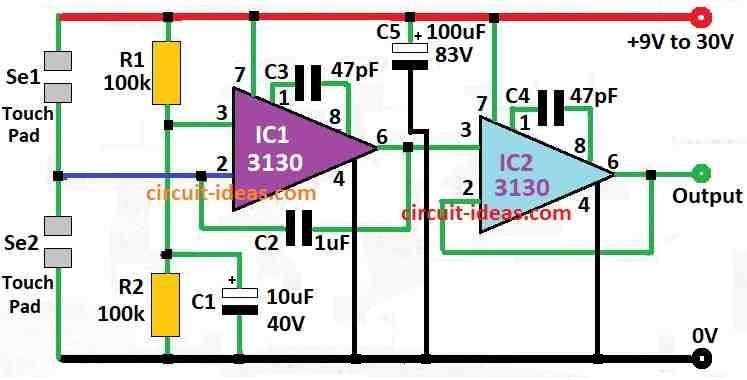
To begin with, this touch potentiometer circuit uses the IC1 CA3130, an op-amp with very high input impedance.
When a finger touches sensor Se1, capacitor C2 (MKT type) charges through the skin, causing the output voltage of IC1 to decrease slowly to zero.
When someone touches sensor Se2 instead, the opposite occurs and the voltage gradually rises until it reaches the supply voltage level.
After when finger is removed, the output voltage stays nearly constant because C2 holds the charge; however, it slowly drops by about 2% every hour.
Also, this kind of touch potentiometer is useful in many things where need of a potentiometer that work by voltage but not by hand turning.
Therefore, if someone does not want a touch sensor, they can use a normal switch or push button instead; they only need to connect a 1M resistor in series, as shown in the circuit diagram.
Formula:
This touch control potentiometer circuit works using capacitive sensing and feedback and to understand when comparator changes its output from high to low, or low to high then we need to know voltage level where this will happen.
Comparator check difference between sensor voltage and a set reference voltage.
Lets say:
- Vcap is the voltage from capacitive sensor circuit
- Vref is the reference voltage which connects to comparators non-inverting input
When Vcap become same as Vref then comparator changes output.
So we say:
Vcap = Vref
This is the point where switching occurs and the exact behavior such as how fast it switches or whether a small delay occurs depends on the comparator IC used.
Datasheet of IC will give that information about hysteresis, speed etc; and if IC 3130 is name of special or unknown chip then please give more details or datasheet so one can understand better.
How to Build:
Below mentioned are the steps to build a Touch Controlled Potentiometer Circuit:
Keep all parts ready:
- First, gather all the required parts and check that they work properly.
Plan circuit design:
- Next, decide where each part will connect and create a layout for the connections and we can follow the given diagram or create your own design using these steps.
Put IC1 CA 3130 in place:
- After that, put the op-amp on breadboard or PCB and connect power pins V+ and V– to right voltage and then connect output pin to other parts in circuit.
Add capacitor C2:
- Now place the MKT type capacitor on board and connect it to right pins of op-amp and then check if capacitor has polarity and if yes then connect correct way.
Connect touch sensors:
- If using touch sensor connect it to right input pin of op-amp and if using switch or button follow instruction like put 1M resistor in series.
Add resistors:
- Put the resistors where needed like shown in diagram.
Power the circuit:
- Give power to circuit and check positive and negative go correct way.
Test the circuit:
- Before fixing parts permanently, test it and then check that the output voltage changes correctly by touching the sensor or pressing the button.
Finish build:
- If circuit works fine fix all parts in place and clean up loose wires.
Optional:
- If required then put circuit inside a box for protection or connect it with bigger project.
Note:
- Always check twice for all wires and parts before turning ON the circuit and if it does not works then check again its wiring and part values to find a problems solution.
Conclusion:
Overall, this Touch Controlled Potentiometer Circuit is easy and smart way for people to use electronics; also it helps a lot when space is small or place not good for normal knobs or buttons.
People also use these circuits in many applications, such as home gadgets, factory machines and human-computer systems.

Leave a Reply