
In many audio circuits, clean power supply is very important, especially pre-amplifier circuits need stable and noise free voltage.
If supply voltage is not stable then hum and distortion may appear in audio output.
Therefore, a regulated power supply is used in this post, as this circuit uses transformer, bridge rectifier, filter capacitors and 7818 voltage regulator IC which converts AC mains voltage into stable 18V DC output.
Also, this Pre Amplifier Power Supply Circuit using IC 7818 Voltage Regulator is simple to build, as it components are easily available and because of that it is good for DIY audio projects.
Circuit Working:
Parts List:
| Components | Specification | Quantity |
|---|---|---|
| Resistor | 1.5k 1/4 watt | 1 |
| Capacitors | Ceramic 0.1uF | 3 |
| Electrolytic 2200uF 35V, 47uF 25V | 1 each | |
| Semiconductors | Voltage Regulator IC 7818 | 1 |
| Standard LED any 5mm | 1 | |
| Bridge Rectifier Diode 1N4007 | 4 | |
| Step Down Transformer Primary 110V/220V AC, Secondary 0-18V AC | 1 | |
| Fuse 0.5A | 1 | |
| ON/OFF Switch | 1 |
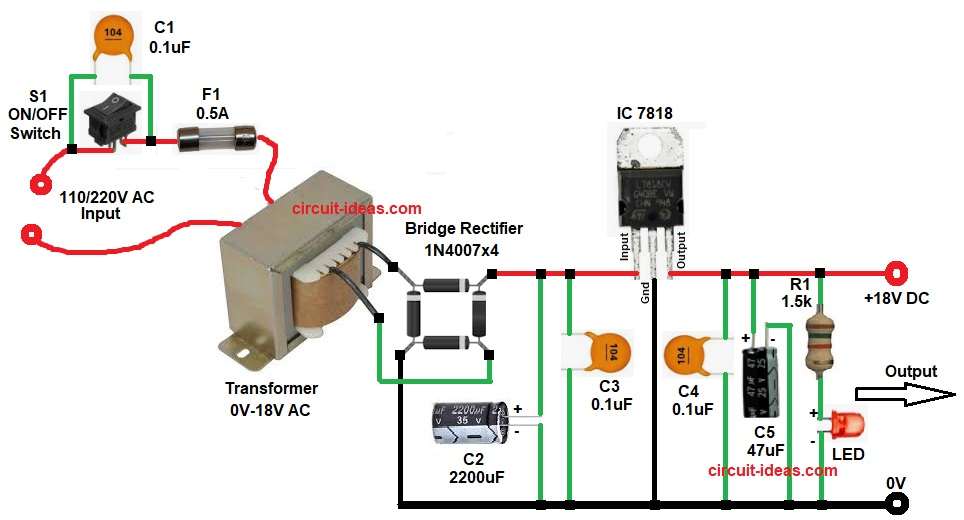
In the above circuit diagram AC mains enters the circuit, then switch S1 is used to turn ON or OFF the power supply, fuse F1 is added for protection. and if high current flows then fuse will blow and protect the circuit.
Next, transformer steps down high AC voltage to 18V AC and after that the AC voltage goes to bridge rectifier made with four diodes D1 to D4.
Bridge rectifier converts AC voltage into pulsating DC voltage, however this DC is not smooth and therefore, large capacitor C2 2200uF is used to filter the ripple.
After filtering the voltage becomes around 25V DC and small capacitor C3 0.1uF removes high frequency noise.
Now this DC voltage goes to IC 7818 voltage regulator and this IC regulates voltage and provides stable 18V output.
At the output side the capacitors C4 and C5 are used for additional filtering and stability and LED with resistor R1 works as power indicator.
Finally, the circuit gives regulated 18V DC output suitable for pre-amplifier circuits.
Formulas with Calculation:
- Ripple voltage formula:
Vripple = I / (f × C)
where,
- I is the load current
- f is the ripple frequency form 100Hz for full bridge
- C is the filter capacitor
Example calculation:
I = 0.1A
C = 2200uF = 0.0022F
f = 100Hz
Vripple = 0.1 / (100 × 0.0022)
Vripple = 0.1 / 0.22
Vripple = 0.45V ripple
This ripple is further removed by the IC 7818 regulator.
2. LED resistor calculation:
Supply voltage is 18V
LED voltage is 2V
LED current is 10mA
R = (Vs − Vled) / I
R = (18 − 2) / 0.01
R = 16 / 0.01
R = 1600 ohm
Nearest standard value resistor R1 used in the circuit is 1.5k.
How to Build:
To build a Pre Amplifier Power Supply Circuit using IC 7818 Voltage Regulator follow the below connection steps:
- Start the circuit first by gathering all the components as per the diagram above.
- Then start, with Transformer primary side connect to AC mains through switch S1 and fuse F1.
Secondary side goes to 18V AC output. - Bridge Rectifier two sides connect to transformer secondary.
- Bridge diode one end connect to capacitor C2 and C3 network and one end of diode connect to GND.
- Filter Capacitor C2 positive pin connect to rectifier positive and negative pin connect to ground.
- Noise Capacitor C3 connect between DC positive and ground.
- 7818 Regulator IC pin 1 connect to filtered DC.
- Pin 2 connect to ground.
- Pin 3 goes to regulated 18V output.
- Output capacitors C4 0.1uF connect between output and ground.
- C5 47uF capacitor connect between output and ground.
- Finally, resistor R1 and LED anode indicator connect in series from output of 18V and LED cathode goes to GND.
Conclusion:
This is a simple and reliable Pre Amplifier Power Supply Circuit using IC 7818 Voltage Regulator for audio pre-amplifier applications which converts AC mains into stable 18V DC voltage.
The transformer reduces voltage, bridge rectifier converts AC to DC, capacitors filter ripple and 7818 regulator provides constant output.
Because of good filtering and regulation the circuit produces low noise supply and therefore, it is very suitable for pre-amp, tone control circuits and other sensitive audio electronics.
Also construction for this circuit is easy, so beginners can build it without difficulty.