
To begin with, a Simple 1 Hz Pulse Frequency Generator Circuit creates one pulse every second and engineers widely use this circuit in clocks, timers and signal generation applications.
Circuit Working:
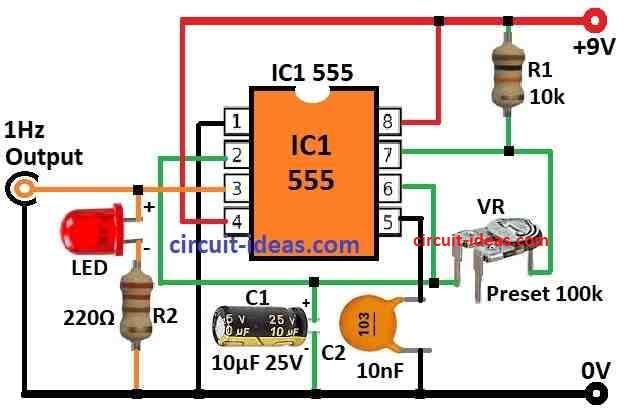
Parts List:
| Components | Values | Quantity |
|---|---|---|
| Resistors | 10k 1/4 watt | 1 |
| 220Ω 1/4 watt | 1 | |
| Preset 100k | 1 | |
| Capacitors | Ceramic 10nF | 1 |
| Electrolytic 10µF 25V | 1 | |
| Semiconductors | IC 555 | 1 |
| LED any 5mm 20mA | 1 |
This is 1Hz pulse maker circuit using popular 555 timer IC works as astable multivibrator.
Here, LED show the output pulses by blinking ON and OFF.
Here, astable multivibrator make wave always so it does not need any trigger like monostable type, that is why it called “free running.”
Furthermore, this circuit is helpful for making clock pulses and time for high and low output depend on 2 resistors and 1 capacitor outside the 555 IC.
Clock means wave go high then low again and again; one high low is one clock cycle and clock has frequency and duty cycle.
Frequency means how many cycles in 1 second and duty cycle means how long it stay high compare to low.
We can set 555 IC for correct frequency by choosing right resistor and capacitor and it can also make duty cycle not equal 50%.
Also, capacitor C1 charge to VCC power through resistors R1 and R2 and when charge go more than 2/3 of VCC then comparator 1 give high and flip flop changes and output becomes low.
Then discharge start pin 7 connects to ground so capacitor C1 start to empty through R2, as capacitor discharge voltage goes down.
When it goes less than 1/3 of VCC comparator 2 go high then flip flop reset and output becomes high.
So output change from low to high and back again and this happen again and again and hence this makes the pulse.
Formula:
The frequency of the 555 timer IC in astable mode is calculated using this formula:
Frequency = 1.44 / ((R1 + 2R2) × C1)
where,
- Frequency is how many cycles happen in 1 second it is in Hertz Hz which means more frequency means more cycles per second.
- R1 and R2 resistors set the timing and they connect to specific pins of the 555 IC.
- C1 is the timing capacitor and it also connects to the IC.
- The value 1.44 is a fixed constant based on the internal design of the 555 timer IC.
How formula works:
555 IC use R1, R2 and C1 to control how fast it charges and discharges and this make the output go high and low again and again.
That gives the frequency and the formula shows how R1, R2 and C1 change the frequency.
Duty Cycle Formula for 555 Timer in Astable Mode:
Duty Cycle = (R1 + R2) × 100 / (R1 + 2R2)
where,
- Duty Cycle is how much time output stays HIGH in one full cycle which is in percent (%).
- 50% duty cycle means output is HIGH half time and LOW half time.
- More than 50% means HIGH time is more.
- Less than 50% means HIGH time is short.
- R1 and R2 are resistors that control timing.
- They connect to special pins on the IC.
How formula works:
R1 and R2 decide how long charging and discharging happens and this changes the time output which stay HIGH or LOW; so it changes duty cycle.
Formula gives the answer in percent.
Important Info:
This formula works only for astable mode of 555 IC and in actual circuit we mostly use only R1 and R2 values to change timing.
Capacitor C1 has small effect and if circuit needs very correct duty cycle we may need better method or calculation.
Charging Time Constant (Tau) for 555 IC:
τ = R1 × C
here:
- τ (tau) is the charging time constant in seconds.
- R1 the resistor connected in the circuit.
- C is the capacitor in farads.
This formula tells how fast capacitor charges in the circuit and bigger R1 or C means slower charging.
How to Build:
To build a Simple 1 Hz Pulse Frequency Generator Circuit we can follow the below steps:
- First, put 555 timer IC on breadboard and then connect pin 1 to ground (GND) rail.
- Next, connect pin 8 to positive (+) rail.
- Then take R1 10kΩ and connect one side to pin 7 of IC and take R2 220Ω and connect one side to LED and also connect other side of R2 to ground.
- Now take C1 10μF and connect positive leg to pin 6 of IC and connect negative leg of C1 to ground.
- After that, connect another capacitor C2 between pin 5 and ground.
- Then connect long leg anode of LED to pin 3 of IC and connect short leg cathode of LED to one side of 220Ω resistor and also connect other side of this resistor to ground.
- Lastly, connect positive wire of power to positive rail and connect negative wire of power to ground rail.
Testing the Circuit:
- Give power to circuit and LED should blink around 1 time per second (1Hz) and this show 555 IC is giving pulses.
Note:
- Parts and values may change based on what one needs and also one may need to change resistor or capacitor to get right blink speed or duty cycle.
Conclusion:
To conclude, Simple 1 Hz Pulse Frequency Generator Circuit is simple but useful circuit it makes pulse every 1 second (1Hz).
Therefore, many electronics projects requiring correct timing or clock signals use this circuit and by using a 555 timer IC in astable mode, we can easily build it.
Finally, we can also change parts to get different frequency if needed.