12 Volt Dual Power Supply Circuit works like two battery in one, as it give two output one is +12V and the other one is -12V and both use same ground.
Furthermore, this circuit greatly benefits electronics projects like audio amplifiers, which require both positive and negative voltages for optimal sound quality.
Also, it provides all the required power in a small and simple circuit.
Circuit Working:
Parts List:
| Components | Values | Quantity |
|---|---|---|
| Capacitors | Ceramic 0.1µF | 2 |
| Electrolytic 1000µF 25V | 2 | |
| Semiconductors | IC 7812 | 1 |
| IC 7912 | 1 | |
| Bridge Rectifier diodes 1N5402 | 4 | |
| Transformer 14-0-14V/1Amp | 1 |
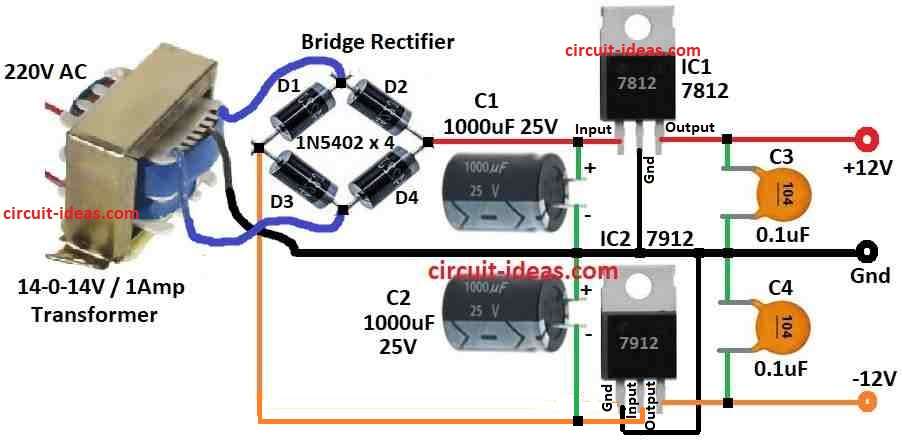
To begin with, this is normal power supply using both positive and negative voltage IC; it give +12V and -12V with same ground and is good for amplifier or other project needing equal power both sides.
Also, it can give 1 amp current and to do this we need to use 14-0-14V, 1 amp transformer which changes 230V AC to around 14V AC.
Then bridge rectifier using 4 diodes 1N5402 D1 to D4 changes AC to DC and capacitors C1 and C2 remove ripple from low voltage AC.
Two voltage regulator ICs create the +12V and -12V outputs.
IC1 is 7812 it gives +12V.
IC2 is 7912 it give -12V.
But IC2 pin is not the same as IC1 so check circuit diagram before connecting it.
Output come from pin 3 of both ICs and we can use this to power our circuit; also capacitors C3 and C4 helps to remove noise so that DC output is clean.
Formula:
How to find filter capacitor value for 12V dual power supply.
We can use this formula:
C = I / (2 × f × Vpp)
where:
- C is capacitor size in farad
- I is current load in ampere
- f input frequency in hertz like 50Hz or 60Hz
- Vpp is ripple voltage from peak to peak in volt
Note:
Use bigger capacitor and than we calculate this by giving better filtering, also if we want very clean voltage which is less ripple then we can also add more filter or use voltage regulator IC.
We can calculate and pick correct value of capacitor using above rule.
How to Build:
To build a 12 Volt Dual Power Supply Circuit follow the below mentioned steps.
How to Make the Circuit:
- First, connect 230V AC power to the input side primary of transformer.
- Next, connect output side secondary of transformer to diode bridge full wave rectifier.
- After that, connect output from rectifier to capacitors C1 and C2 and be careful with + and – sides.
- Then connect output from capacitors to input pins of voltage ICs.
- Now connect output pin 3 from ICs to capacitors C3 and C4 and again check polarity (+/-).
Check Everything:
- Use multimeter to check output voltage at ICs pin 3 and we should see +12V from 7812 and -12V from 7912.
- Voltage must be stable.
Adjust If Needed:
- If voltage is not right change parts or check the connections.
Box It Up:
Final Check:
- Do last test to be sure circuit gives correct voltage and works well.
Be Careful:
- This project use high voltage 230V so be very careful and if anyone do not know much about electronics then ask someone who knows or get help from expert.
Conclusion:
To conclude, a 12 Volt Dual Power Supply Circuit provides two outputs: +12V and -12V, both connected to the same ground.
Moreover, people mostly use this circuit in electronics projects that require equal power on both sides, such as audio amplifiers.

Leave a Reply