Transistor Based H-Bridge Motor Controller Circuit controls DC motor spin both ways like clockwise, anticlockwise.
Also, the circuit helps control speed and direction by easy switch method.
Name “H-Bridge” comes from shape like letter H which has 4 switches and in this post circuit is 4-transistor H-Bridge.
Furthermore, circuit is good for robotics, automation and other motor projects and also motor must not take more than 600mA.
Power supply should be 3 to 15V DC as motor needs.
Circuit Working:
Parts List:
| Components | Values | Quantity |
|---|---|---|
| Resistors | 1k 1/4 watts | 4 |
| Semiconductors | Transistors 2N2907 PNP | 2 |
| Transistors 2N2222 NPN | 2 | |
| Diodes 1N5817 | 4 | |
| DC Motor 500mA Permanent Magnet Type | 1 |
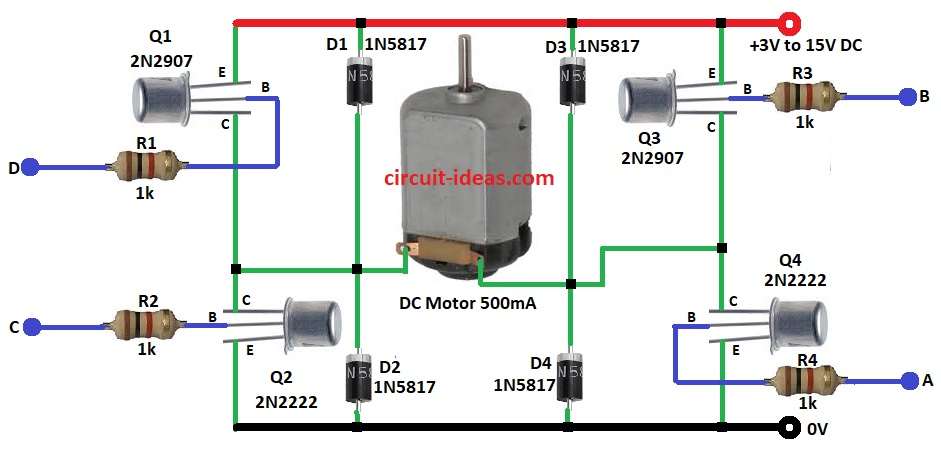
H-Bridge uses 4 transistors Q1, Q2, Q3, Q4 in shape like letter “H” around its motor and inputs A, B, C, D control transistors and chooses motor forward, reverse, stop or brake.
Forward: Q1 PNP ON, Q4 NPN ON and Q2, Q3 OFF.
Current flows from Vcc through Q1 and then through motor and then through Q4 to ground.
Reverse: Q3 PNP ON, Q2 NPN ON and Q1, Q4 OFF.
Current flows from Vcc through Q3 and then through motor and then through Q2 to ground.
Stop: All diagonal transistor pairs OFF with no current and motor stops.
Brake: The same-side pair turns ON Q1 and Q3 or Q2 and Q4 and this action shorts the motor terminals to bring a quick stop.
Diodes D1 to D4 protect from back EMF and resistors R1 to R4 1k each limit base current and protect transistors and help smooth switching.
than 2W rating then transistor will work safely.
How to Build:
To build a Transistor Based H-Bridge Motor Controller Circuit follow below steps for connection:
- First, gather all parts as from circuit diagram.
Connection of Q1:
- Next, Q1 base connects to signal D through R1, Q1 emitter connects to +3V to +15V DC and then Q1 collector connects to Q2 collector.
Q2 Connection :
- After that, Q2 base connects to signal C through R2, Q2 emitter connects to GND and then Q2 collector connects to Q1 collector.
Connection of Q3:
- Now, Q3 base connects to signal B through R3, Q3 emitter connects to +3V to +15V DC and Q3 collector connects to Q4 collector.
Connection of Q4:
- Then Q4 base connects to signal A through R4, Q4 emitter connects to GND and then Q4 collector connects to Q3 collector.
- Finally, diodes D1 to D4 connects across emitter and collector of Q1 to Q4.
Conclusion:
Overall, Transistor Based H-Bridge Motor Controller Circuit with PNP + NPN transistors control DC motor forward and backward.
Also, circuit is cheap and easy to build and it needs right transistors and resistors for good work; furthermore, the circuit is best for robots, automation and for small motors.

Leave a Reply