This is Simple 9V Transistor Inverter Circuit using 9V battery, which is very small and easy to make and which helps to understand DC to AC working.
Circuit uses only few low cost parts and its output power is very low and also it is only for testing and learning and further is useful for students and beginners.
Circuit Working:
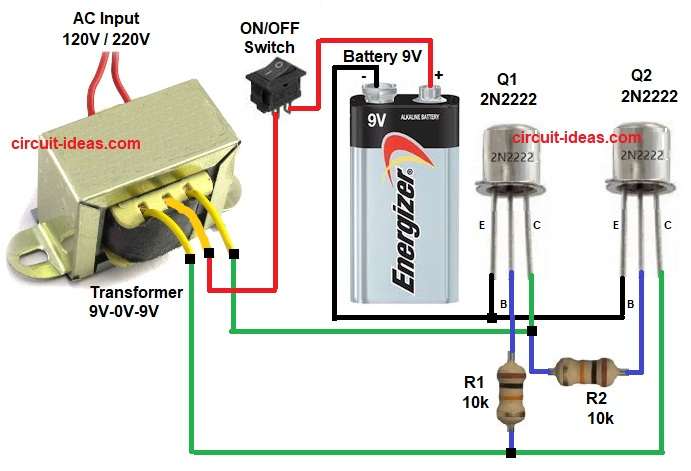
Parts List:
| Components | Values | Quantity |
|---|---|---|
| Resistors | 10k 1/4 watt | 2 |
| Semiconductors | Transistors 2N2222 | 2 |
| Battery 9V DC | 1 | |
| ON/OFF Switch SPST Switch | 1 | |
| Transformer 9V-0V-9V Primary, 120V or 220V Secondary | 1 |
The battery supplies 9V DC power, and the switch turns the circuit ON and OFF; the transformer primary has a center tap, and its center tap connects to the battery’s positive terminal.
After that, two transistors work in push pull way like when Q1 is ON then Q2 is OFF and when Q2 is ON then Q1 is OFF and this ON and OFF action makes AC current in transformer.
Now transformer increases the voltage and AC output comes from secondary side and this output is not pure sine wave, it is square wave type AC.
Formula with Calculation:
Below is the formula for Simple 9V Transistor Inverter Circuit:
Battery voltage = 9 and primary voltage per half winding = 9V
If transformer is 9-0-9 / 220V, then turns ratio = 220 / 9 = 24.4
Output voltage approximately = 9 x 24 and output voltage = about 220V AC
Base resistor value = 10 and base current = 9V / 10000
Base current = 0.9 mA
Hence, this current is enough for small transistor switching.
How to Build:
To build a Simple 9V Transistor Inverter Circuit follow the below steps for connection:
- First, take all parts same as circuit diagram.
- Next, transformer center tap connect to battery positive using switch.
- Then both side of transformer primary connect to collector of Q1 and Q2.
- After that, emitter of Q1 and Q2 connect to battery negative and base of Q1 and Q2 connect to R1 and R2 resistors.
- Also, other end of R1 and R2 connect to collector of Q1 and Q2.
- Finally, battery negative a common ground.
Conclusion:
To conclude, this Simple 9V Transistor Inverter Circuit is good for basic learning, as circuit uses very few parts and its working is easy to understand.
Moreover, output power is very small but it is not for real AC appliance use, also the circuit is best for students, practice and experiment purpose.

Leave a Reply