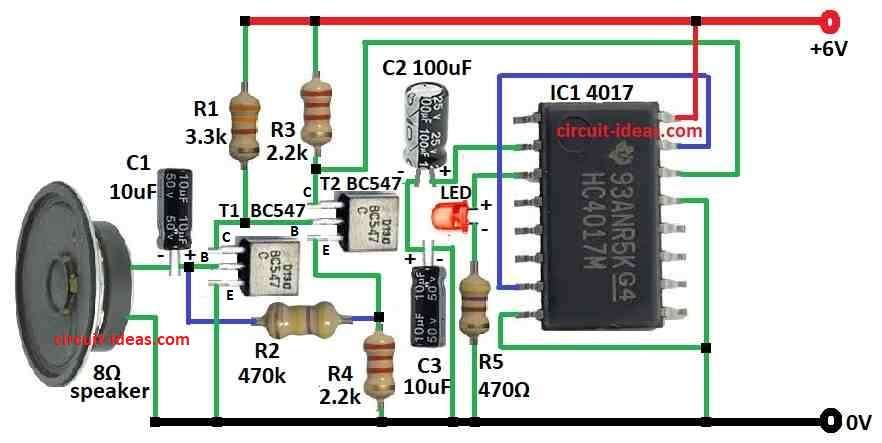
The Clap Switch Circuit using IC 4017 turns ON and OFF with a clap sound; it uses a speaker as a microphone because both components have a similar construction; therefore, a speaker can also work as a microphone in this circuit.
Circuit Working:
Parts List:
| Components | Values | Quantity |
|---|---|---|
| Resistors (All resistors are 1/4 watt) | 3.3k | 1 |
| 470k | 1 | |
| 470Ω | 1 | |
| 2.2k | 2 | |
| Capacitors | Electrolytic 10μF | 2 |
| Electrolytic 100μF | 1 | |
| Semiconductors | IC 4017 | 1 |
| Transistors BC547 | 2 | |
| LED any 5mm 20mA | 1 | |
| Speaker 8Ω | 1 |
To begin with, this circuit is clap switch with 4017 decade counter IC, as it uses speaker like microphone; also each clap turn ON the next LED.
Therefore, LEDs glow one by one with each clap.
How it work:
Speaker act like microphone and a clap make small voltage in speaker.
Transistor T1 BC547 get this voltage from capacitor C1 and make it stronger and transistor T2 BC547 work like Schmitt trigger.
Resistor R2 set working point of T1 and capacitor C2 stop DC from going next part.
Also, it switches fast when voltage reach certain level and this help reduce noise.
R3 and R4 set trigger levels.
Furthermore, the output from T2 goes to pin 14, which acts as the clock pin of the 4017 IC and pin 15 serves as the reset pin, and when it goes low, the counter resets to output 0 at pin 3.
R5 keep reset pin high so IC keeps working and pin 16 is inhibit pin but not used here.
4017 IC has 10 output pins from pin 3 to pin 11 and with each clap the clock pulse next pin goes high, moreover, output pin connect to LED with resistor R5.
LED turns ON when output is high.
No clap then pin 14 is low and T2 output is low and first LED pin 3 is ON.
Finally, clap makes voltage spike which goes through T1 and T2 to pin 14 and it gives clock pulse and counter move to next output pin 4 and next LED turns ON.
Formulas:
BC547 Biasing Resistors:
To make the BC547 work correctly, use proper resistors and we can calculate the base current (IB) by using the following formula:
IB = (Vin − VBE) / RB
where,
- VBE is about 0.7V for silicon transistor.
4017 IC Timing:
To control how fast LEDs switch we used resistor and capacitor.
Time (T) = 0.7 × RT × CT
where,
- RT is timing resistor
- CT is timing capacitor
This sets pulse length or gap between claps.
LED Current Limiting Resistor:
To protect LED use resistor in series:
RLED = (Vcc − VLED) / ILED
where,
- Vcc is the power voltage
- VLED is the voltage drop across LED
- ILED the current needed for LED
Design Notes:
When making clap switch choose right values for resistors and capacitors and this ensures circuit works well, hears claps and lights LEDs in order.
Therefore, engineers do not always need exact calculations, but they still require proper design for good performance.
How to Build:
To build a Clap Switch Circuit using IC 4017 we need to follow the below mentioned connections process:
- First, connect pin 2 of IC 4017 to C2 and C3 other sides of capacitor goes to ground.
- Next, connect pin 3 of IC 4017 to LED and R5 other side to ground.
- Join pin 7 and pin 15 together and then connect pin 8 and pin 13 to ground.
- Now connect pin 16 to +6V supply.
- Also, connect pin 14 between T2 collector and resistor R3.
- After that, T1 collector goes to one side of R1 and other side of R1 to +6V, T1 base connect to C1 and one wire of 8Ω speaker and other wire of speaker to ground and then T1 emitter goes to ground.
- Then T2 collector connects to one side of R3 other side to +6V, T2 base connects to R1 and T1 collector and T2 emitter goes to ground through R4.
- Finally,R2 connect between T1 base and point between T2 emitter and R4.
Extra Notes:
- Speaker is not best as mic, so better to use condenser mic which is more sensitive to sound.
- Background noise can make circuit too sensitive and we can change resistor values to reduce noise effect.
- LED only stays ON for short time and to keep it ON longer we need extra circuit.
Conclusion:
Overall, Clap Switch Circuit using IC 4017 switches turns ON / OFF device by sound.
A speaker can work, but a condenser microphone provides better reliability and sensitivity, as a result, designers do not use speakers for sound detection; however, noise can still trigger them.

Leave a Reply