This article for Super Sensitive Intruder Alarm Circuit talks about very simple but strong intruder alarm circuit, also it is very sensitive.
Furthermore, this circuit is useful for security and it can detect very small Interference.
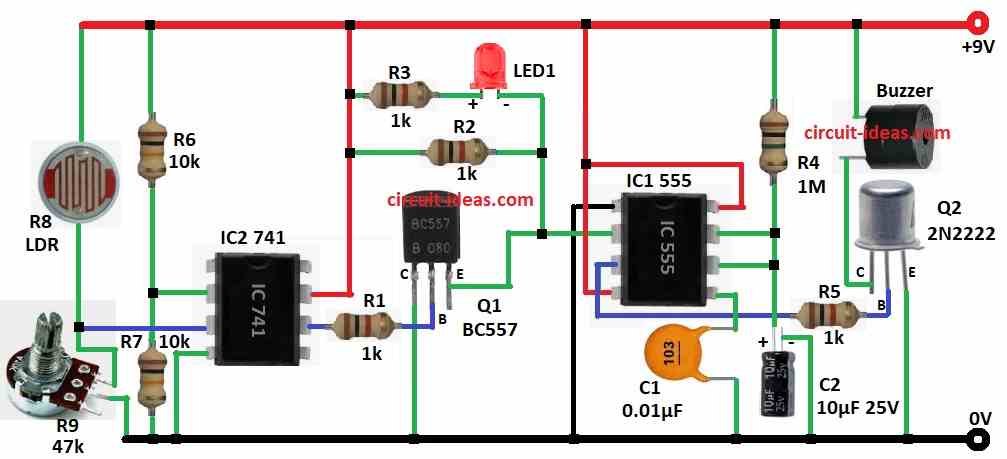
This circuit uses IC 741 op-amp and IC 555 timer to work and it also use LDR (light sensor) as main part so it can feel small light changes.
Circuit Working:
Parts List:
| Components | Values | Quantity |
|---|---|---|
| Resistors (All resistors are 1/4 watt unless specified) | 1k | 4 |
| 1M | 1 | |
| 10k | 2 | |
| LDR | 1 | |
| Potentiometer 47k | 1 | |
| Capacitors | Ceramic 0.01µF | 1 |
| Electrolytic 10µF/25V | 1 | |
| Semiconductors | IC 741, 555 | 1 each |
| Transistor BC557 PNP | 1 | |
| Transistor 2N2222 NPN | 1 | |
| Buzzer | 1 | |
| LED any 5mm 20mA | 1 |
To begin with, in this post alarm goes OFF even if intruder walk few meters away.
First, LDR and R9 potentiometer work like voltage divider and LDR changes resistance when light change.
More light means less resistance and this change makes voltage across R9 also change.
Then IC2 741 op-amp compare this voltage which is non-inverting input with fixed voltage from other resistors like inverting input.
If LDR voltage is higher then reference voltage, then IC2 output goes high and then Q1 BC557 turns ON and send low pulse to pin 2 of IC1 555 timer.
After that, IC1 work in monostable mode then it gives high output for some time to set by R4 and C2 and this high output turns ON the Q2 2N2222 which starts the buzzer.
Also, LED1 turns ON to indicate that the circuit has detected an intruder.
Formulas with Calculations:
Below are simple calculations for Super Sensitive Intruder Alarm:
Monostable Output Time (555 Timer):
T = 1.1 × R4 × C2
where,
- R4 is the 1 meg ohm
- C2 is 10µF
T = 1.1 × 1,000,000 × 0.00001 = 11 seconds
So buzzer stays ON for 11 sec after trigger.
How to Build:
To build a Super Sensitive Intruder Alarm Circuit follow the below mentioned steps:
- First, take all parts as shown in circuit diagram.
IC1 555 timer:
- Next, pin 1 connects to GND
- Then pin 2 connects to emitter of Q1 and pin 3 connects to base of Q2 through resistor R5
- After that, pin 4 & pin 8 connects to +9V
- Now pin 5 goes to GND through capacitor C and then pin 6 & pin 7 connect with resistor R4 to +9V and capacitor C2 goes to GND
IC2 741 op-amp:
- First, pin 2 which is the inverting pin goes between resistors R6 (+9V) and R7 (GND)
- Then pin 3 which is the non-inverting pin goes between LDR (R8 to +9V) and pot (R9 to GND)
- Now pin 4 connects GND and pin 6 connects to base of Q1 through resistor R1
- After that, pin 7 connects to +9V
- Also, LED1 + R3 connects between pin 7 of IC2 and pin 2 of IC1
- Lastly, R2 connects between pin 7 of IC2 and pin 2 of IC1
Q1 BC557 transistor:
- Now Q1 collector connects to GND, base goes to pin 6 goes to IC2 and then emitter goes to pin 2 of IC1
Q2 2N2222 transistor:
- Then collector connects to one leg of buzzer and other leg of buzzer goes to +9V, base goes to pin 3 of IC1 and then emitter connects to GND
Conclusion:
To conclude, this Super Sensitive Intruder Alarm Circuit is easy and works well, it uses LDR to catch small light changes and is good for doors, windows etc.
Finally, we can also change potentiometer to make it more or less sensitive and it is good project to learn electronics and improve home security.

Leave a Reply