To begin with, this Simple Siren Circuit article show how to make circuit sound like real siren! here, the sound goes up and down fast like police car or ambulance siren.
Also, building this type of circuit is fun, but remember that people use sirens during emergencies.
Circuit Working:
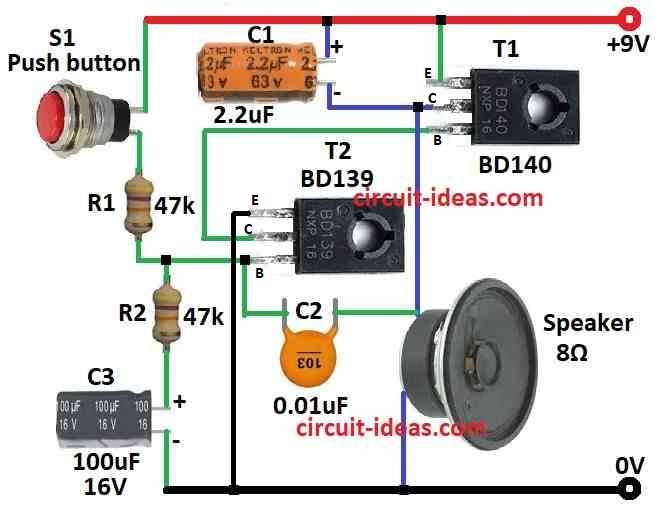
Parts List:
| Components | Values | Quantity |
|---|---|---|
| Resistors | 47k 1/4 watt | 2 |
| Capacitors | Ceramic 0.01μF | 1 |
| Electrolytic 2.2μF 16V | 1 | |
| Electrolytic 100μF 16V | 1 | |
| Semiconductors | Transistor BD140 | 1 |
| Transistor BD139 | 1 | |
| Push Button | 1 | |
| Speaker 8Ω | 1 |
This circuit uses generator with both PNP and NPN transistors to make siren sound.
The transistors work together to continuously produce sound and engineers call this circuit a free-running multivibrator.
Also, capacitor C2 can make one steady sound when connect to power line; but in this article we want siren sound which is not same sound all time.
So we put RC circuit with resistor R2 to make sound go up and down and when we press switch S1, capacitor C1 charges slowly through R1 until it reaches about 4V.
As a result, as voltage goes up the time at R2 and C2 point get shorter so sound frequency goes higher.
So when we let go switch S1 then capacitor C1 drain slowly so sound goes lower and because of this waveform look like sawtooth.
Hence, the speaker produces a rising or falling tone depending on whether switch S1 is pressed.
Formulas:
Main goal of this transistor siren circuit is to make sound like real siren with frequency that can change.
Also, this type of circuit uses two transistors with resistors and capacitors in a special cross-coupled design to change the output waveform and sound.
Here is some easy formulas and steps to help make this circuit:
Frequency of Oscillation (f):
Use this formula to find how fast the circuit makes the sound:
f = 1 / (2 * π * √(R1 * R2 * C1 * C2))
where:
- R1 and R2 resistors connected to the transistors.
- C1 and C2 capacitors connected with R1 and R2.
This give frequency in Hertz Hz.
Duty Cycle D:
Use this to find how long sound stay high or low:
D = R2 / (R1 + R2)
To make it in percent, multiply result by 100.
Note:
Using this formula and steps we can build siren circuit with transistors and if we want different siren sound or speed then just change value of parts like resistors or capacitors.
How to Build:
For building a Simple Siren Circuit follow below steps for connections:
- First, find right values for resistors R1, R2, capacitors C1, C2 and transistors PNP and NPN which we need for our design.
- Next, place the PNP and NPN transistors on breadboard like in the circuit diagram.
- Then connect positive and negative wires from power supply to breadboard.
- Now connect the transistors to build free running multivibrator.
- After that, join collector, emitter and base like shown in circuit diagram.
- Connect capacitor C2 carefully to avoid disturbing the multivibrator and make sure C2 does not connect to the positive power line.
- Then connect resistor R2 in parallel with capacitor C1 and this help make sound go up and down with rising and falling frequency.
- Now connect switch S1 so that when we press it C1 will charge and when we release switch, C1 will slowly discharge.
- Next, put speaker to output side of multivibrator so we can hear sound and turn ON the power and press release switch.
- Also, we will hear siren type sound coming from speaker and if sound is not perfect then change some part values and test again.
- Lastly, try different R or C values to get sound we like.
Important Note:
- This is just a simple guide, exact parts and values depend on our design and if we do not know electronics much then ask expert or take help.
- Also, be careful while working with electronics and always follow safety rules.
Conclusion:
To conclude, we can build a simple siren circuit in many ways depending on the type of sound we want.
Moreover, people use siren circuits in police cars, fire alarms, security systems, and other applications that require loud changing sounds.

Leave a Reply