We already see many temperature detector circuits in out previous blogs, but in this project we show a simple temperature detector circuit, here we use LM335 temperature sensor as good sensor IC and TL071 op-amp IC as comparator.
Now, the circuit senses temperature and then gives alert using buzzer when temperature crosses set level, so we can use this circuit for room monitoring, battery protection and also for small lab experiments.
Also, this Temperature Sensing Alarm Circuit using buzzer is very simple and easy to build, because it uses basic components, therefore beginners can also make it easily.
This circuit works on simple 9V power supply, so no complex design is needed.
Circuit Working:
Parts List:
| Components | Values | Quantity |
|---|---|---|
| Resistors | 5.6k, 8.2k, 3.9k, 470Ω | 1 each |
| Presets 10k,1k,100k | 1 each | |
| Semiconductors | Temperature Sensor IC LM335 | 1 |
| Comparator IC TL071 | 1 | |
| Transistor PNP BC557 | 1 | |
| Buzzer 9V | 1 | |
| Power Supply 9V Battery / Adapter | 1 |
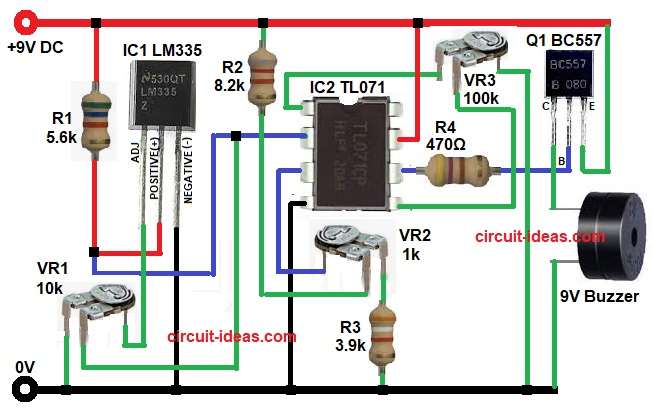
The LM335 temperature sensor gives output voltage based on temperature and it works like temperature dependent on Zener diode, so when temperature increases then output voltage also increases.
Now, resistor R1 gives bias current to IC1 LM335, also VR1 adjusts calibration of sensor output and therefore it helps to match correct temperature reading.
Then, the output from LM335 goes to inverting input pin 2 of IC2 TL071 op-amp IC and at the same time, R2, VR2 and R3 make voltage divider, so it creates reference voltage.
After that, we can set this voltage based on required temperature limit and also, VR3 adjusts sensitivity and makes output more stable.
Next, non-inverting input pin 3 gets this reference voltage and then op-amp compares both voltages, if sensor voltage becomes higher than reference voltage, then output at pin 6 changes its state.
Finally, this output goes to transistor Q1 through resistor R4, so when Q1 turns ON the current flows through buzzer and buzzer produces sound alert.
How to Build:
To build a Temperature Sensing Alarm Circuit using Buzzer follow the below connection steps:
- First, the circuit starts by collecting all components as shown in diagram above.
- Then, start with LM335 temperature sensor IC1 with pin positive connect to resistor R1, one end of VR1 and also to pin 2 of IC2.
- Next, pin negative connect to ground, also Adj pin connect to center pin of VR1, so we can do calibration.
- Now, move to TL071 op-amp IC2 pins 1 and 5 connect to VR3 and therefore, offset control is possible.
- Then pin 2 connect to junction of R1 and positive pin of IC1.
- After that pin 3 connect to center pin of VR2 preset.
- Next, pin 4 connect to ground.
- Then pin 6 goes to base of transistor through resistor R4.
- And last pin 7 connect to +9V supply.
- Next, take transistor BC557 transistor and connect emitter to +9V power supply.
- Then, collector connect to one end of buzzer and other end of buzzer connect to ground.
- After that, base pin connect through resistor R4 to output pin 6 of IC2.
- Now, connect resistors R1, VR2 and R3 in series from +9V supply to ground, so it forms voltage divider.
- Finally, connect VR1 preset with one end connect at junction of R1, positive pin of IC1 and pin 2 of IC2.
- Then, middle pin connect to Adj pin of IC1 and last pin connect to ground.
Conclusion:
This Temperature Sensing Alarm Circuit using Buzzer gives simple and effective temperature detection.
We can easily adjust trigger temperature using preset, as this design uses analog components so it works fast and reliably.
We can modify it by adding relay or LED indicators, as this project helps beginners understand sensors, op-amps and comparators in practical way.

Leave a Reply