LEDs are small light sources that consume less power and produce high brightness.
Different types of LEDs, such as standard LEDs, high-power LEDs, RGB LEDs, and SMD LEDs, serve various applications, including TVs, flashlights, displays and decorative lighting.
Therefore, today LED is everywhere and is very important part in human life.
Working Principle of LEDs:
LED work on semiconductor principle and inside LED there are two part: P-type (positive) and N-type (negative).
When electricity flow the electron from N-side meet hole from P-side and this meeting release energy as photon light.
Also, light color like red, green, blue, white depend on material use.
Other things in working:
Forward Bias: LED work only when current goes forward.
Low Heat: LED make very less heat than normal bulb.
Efficiency: More power become light with less waste.
Brightness Control: Brightness change by more or less current or by PWM.
Different Types of LEDs:
Through-Hole LEDs:
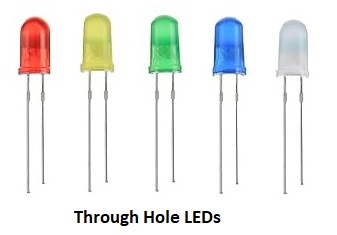
Common LEDs have two leads for circuit boards., which come in sizes 3mm, 5mm, 10mm and they are simple indicators in machines, toys, student projects, small circuits and in power ON/OFF lights.
Surface Mount LEDs (SMD LEDs):
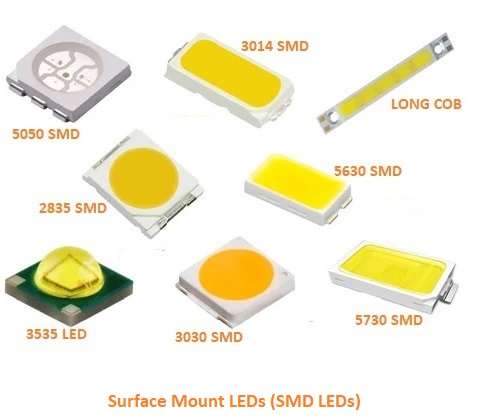
SMD LEDs mount directly on PCB, they are small, bright and very efficient.
These LED strips decorate flat panel displays, TV and mobile screens, automotive dashboards and traffic lights.
High Power LEDs:

High Power LEDs handle high current and give strong light and they need good cooling like heat sinks.
Furthermore, high-power LEDs provide intense illumination and people commonly use them in flashlights, car headlights, stage lighting, floodlights and emergency lamps.
RGB LEDs:
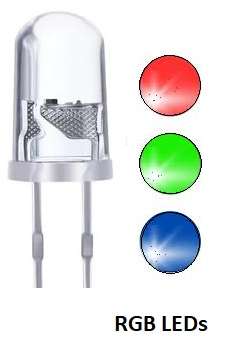
RGB LEDs have red, green and blue chips in one package and changing each colors brightness makes many colors.
People also use them in decorative color-changing lights, advertising boards, disco lights, LED TVs, smart bulbs for mood lighting and festival lights.
Infrared (IR) LEDs:
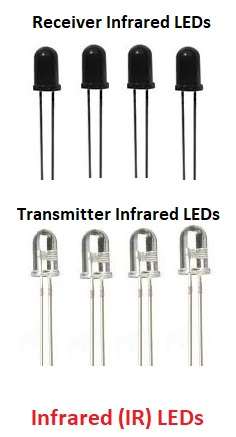
IR LEDs give light which we human can not see.
Infrared (IR) LEDs emit infrared light and commonly feature in TV and air-conditioner remote controls, CCTV night vision systems, automatic door sensors, line-following robots and biometric systems.
Ultraviolet (UV) LEDs:
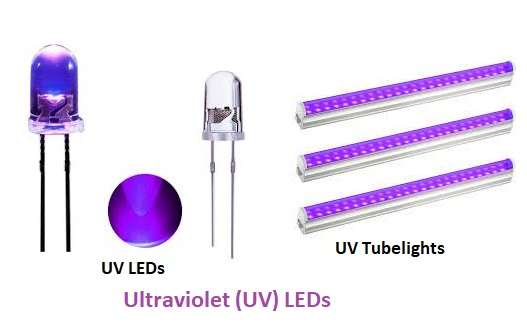
UV LEDs emit ultraviolet light and help sterilize water and air, cure dental fillings, detect counterfeit money, dry nail polish and support forensic crime investigations.
Organic LEDs (OLEDs):
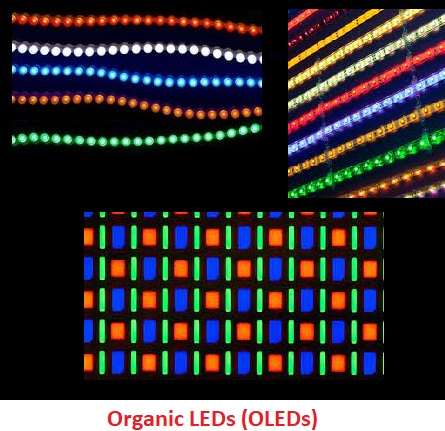
OLEDs use organic semiconductors to make light and they are flexible and show true colors with high contrast.
Manufacturers use OLEDs in premium smartphone displays, smart TV panels, smartwatch screens, flexible electronic newspapers, and transparent displays.
Micro LEDs:
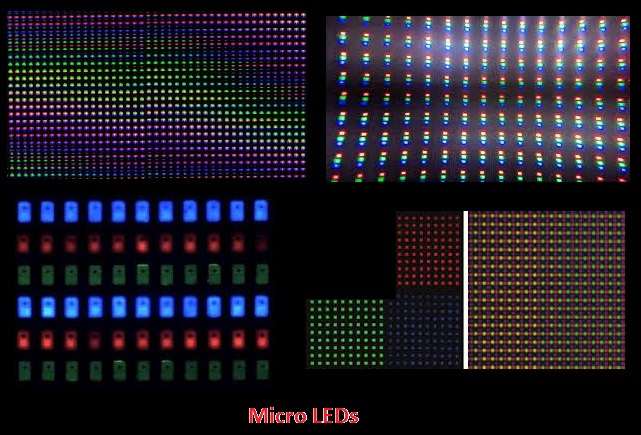
Micro LEDs combine tiny size, high brightness and efficiency, which allows manufacturers to use them in high quality AR and VR glasses, next generation TVs, smartwatches and high-resolution large digital billboards.
COB (Chip on Board) LEDs:
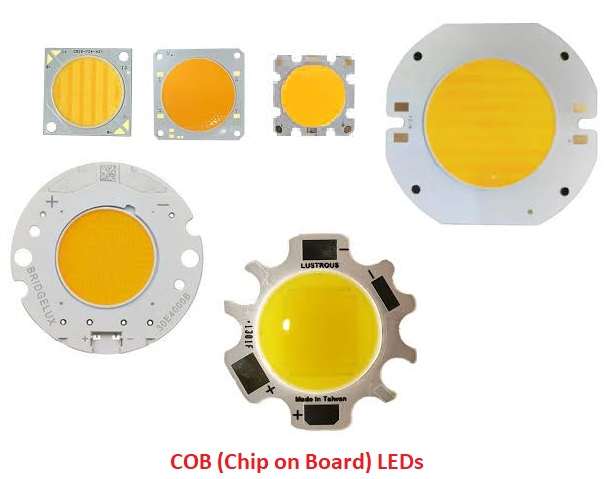
COB LEDs combine many chips into a single module, making them very bright.
Consequently, people commonly use them in ceiling spotlights, industrial workshop lamps, stage lights, home downlights and stadium floodlights.
Features and Functions of LEDs:
1. Through-Hole LEDs:
- It have two long pins means legs and easy legs to connect in breadboard or circuit
- Available in many colors with low cost and in simple design
- Strong body and is not very fragile
2. Surface Mount LEDs (SMD LEDs):
- SMD LEDs have a very small, flat design and do not use long pins, and manufacturers mount them directly onto the PCB.
- Can fit in many small area.
- SMD LEDs provide more brightness than through-hole LEDs and manufacturers commonly use them in LED strips and displays.
3. High Power LEDs:
- Very bright and produce strong light and need heat sink for cooling
- Can run on higher current and is with long life with proper cooling
- People also use it for powerful lighting applications.
4. RGB LEDs:
- Have three colors inside it like Red, Green and Blue and can make millions of colors by mixing
- Controlled by microcontroller or driver and is bright and attractive
- Moreover, used for decoration and displays
5. Infrared (IR) LEDs:
- Emit invisible light which we cannot see by eye and uses low power consumption
- Work with sensors and camera and can transmit signals over distance
- Also, is safe and reliable
6. Ultraviolet (UV) LEDs:
- Emit UV light which is not fully visible and can kill germs and bacteria
- Manufacturers use special materials to make UV LEDs, so users must handle them carefully because excessive UV exposure can be harmful.
- In addition , its used for sterilization and detection
7. Organic LEDs (OLEDs):
- Made with thin organic material films, which is very thin and light weight
- Can be flexible or bendable and is with high brightness and sharp contrast
- Better color quality than normal LED
8. Micro LEDs:
- They come in extremely small size LED, with high brightness even in sunlight
- Very low power use and is with very long lifespan
- Can make very high-resolution display
9. COB (Chip on Board) LEDs:
- Many LED chips work together on a single board to produce smooth and uniform light
- Less glare, wide beam angle and is very efficient with more light per watt.
Extra Information:
1. General Advantages of LEDs:
- Use less power compared to old bulbs with energy saving and is very long life and can work 25,000 to 50,000 hours.
- Come in small in size but gives bright light and are also available in many colors without filters.
- Produce less heat and is safe to use and is environment friendly with no mercury like CFL.
2. Limitations of LEDs:
- Cost more than normal bulbs but saving in long run.
- Some types need extra cooling like high power LEDs and are sensitive to wrong voltage and current or else it can burn.
- Light beam angle sometimes narrow, need lens and different user.
3. Applications of LEDs:
Household: Lamps, tube lights, decorative lights.
Automotive: Car headlights, dashboard lights, indicators.
Electronics: Remote control, sensors, displays.
Medical: UV LEDs for sterilization, IR LEDs for therapy.
Industrial: Street lights, flood lights, factory lighting.
Displays: TVs, smartphones, advertising boards, wearables.
4. Future of LEDs:
- Micro LEDs and OLEDs are future for display technology like TV, VR and phones.
- Smart LEDs connected with IoT for smart homes and more eco-friendly lighting are replacing traditional bulbs fully.
- Development of flexible and transparent LEDs for new devices.
5. Safety Notes:
- IR and UV LEDs are not visible but they can still be strong so we must use is carefully.
- High-power LEDs generate heat, so they require proper cooling.
- Direct looking into bright LED for long time can hurt eyes.
Conclusion:
Overall, in this post for Different Types of LEDs: A Comprehensive Guide LEDs come in many different types.
Through-hole LEDs provide simple lighting solutions, high-power LEDs deliver strong illumination and OLEDs and Micro LEDs offer advanced display technologies, also each type serves a unique purpose in our daily lives.
Hence, from remote control to street light and from phone screen to smart home, LEDs are everywhere and they save energy and give bright light and help technology move forward.

Leave a Reply